Minister of Finance, Economic Planning and Decentralisation Joseph Mwanamvekha yesterday presented the 2025/26 Mid-Year Budget Review, unveiling a fiscal picture marked by widening deficits, revenue shortfalls and intensifying spending pressures that have forced government to revise the National Budget upwards by K512.6 billion, from K8.077 trillion to K8.589 trillion.
Mwanamvekha took more than an hour to deliver the statement to a packed Chamber, maintaining a calm and controlled tone throughout. He repeatedly assured legislators that the revised budget would “restore order and fiscal credibility” despite the shocks experienced in the first half of the financial year.
In a rare show of bipartisan unity, members of Parliament from both sides of the aisle rose to applaud the minister at the end of his speech—an endorsement that underscored the political weight carried by this mid-year fiscal reset.
Macroeconomic fundamentals shift
The review confirms that the macroeconomic assumptions underpinning the original budget no longer hold. Economic growth for 2025 has been revised downwards to 2.7 percent, reflecting disruptions caused by protracted fuel shortages, foreign exchange constraints and rising production costs across manufacturing, distribution and retail.
Inflation remains far above the projected path.

Former minister of Finance and Economic Affairs Simplex Chithyola-Banda expected inflation to average 22.3 percent in the 2025. However, Mwanamvekha assumes that inflation will remain elevated at 28.5 percent in 2025. This is 620 basis points above the figures used during the formulation of the annual budget.
The Minister cautioned that money supply growth—now exceeding 50 percent—poses immediate inflationary risks and undermines the stability of the kwacha.
“The first-half of this fiscal year was presided over by the Malawi Congress Party Government. During this period, we saw persistent revenue underperformance, cost overruns, unsustainable deficits and high public debt service,” he said, positioning the review as both a corrective measure and a stabilisation effort.
Foreign exchange reserves remain strained as import demand continues to outpace supply, worsened by the expiry of the IMF programme and delays in donor-funded projects.
Revenue performance weakens, grants undershoot target
Government projected K2.711 trillion in revenue and grants for the first-half of the year. Instead, it collected K2.383 trillion, representing a 12.1 percent shortfall.
Domestic tax revenue also underperformed, delivering K2.057 trillion compared to the projected K2.139 trillion, largely due to reduced import volumes as forex shortages constrained trade.
The steepest underperformance came from foreign grants. Government received K325.5 billion against a projection of K571.4 billion, a drop of 43 percent, reflecting procurement bottlenecks and slower disbursement from cooperating partners. Dividends from State-Owned Enterprises reached only K5.93 billion, far below the expected K29.8 billion.
Spending pressures intensify across key votes
Expenditure rose faster than anticipated, with mid-year outturns reaching K4.420 trillion, above the projected K4.244 trillion. Recurrent spending stood at K3.502 trillion, exceeding targets by K281.8 billion.
Wages and salaries exceeded projections by K125.9 billion, reflecting large recruitment drives in health, education and the security cluster, alongside increased honoraria for traditional leaders. Election spending rose from K162.9 billion to K212.9 billion, a 30.7 percent overrun.
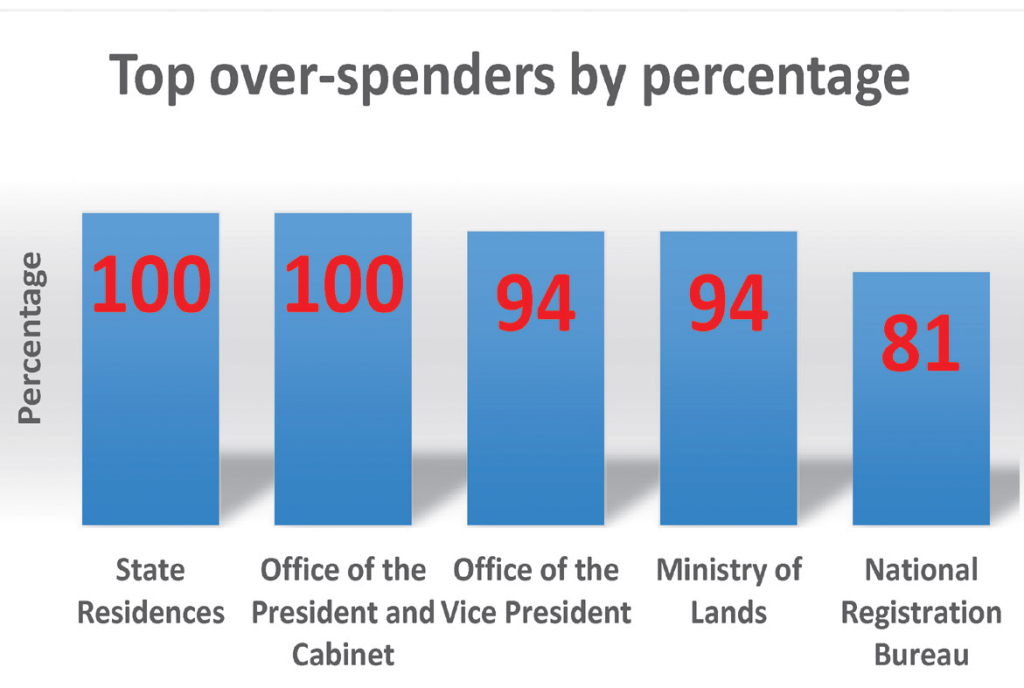
Several key government votes—including State Residences, the Office of the President and Cabinet, and the Office of the Vice-President—recorded utilisation rates approaching or exceeding 100 percent by September. Expenditure on goods and services reached 71 percent of the approved annual allocation within six months.
While foreign-financed development projects lagged due to import restrictions and forex shortages, domestically financed projects overspent by K129 billion, partly due to inflated certificates of works and accelerated implementation of locally funded programmes.
Deficit widens as borrowing pressures grow
The cumulative outcome is a significantly wider deficit than expected. By September, the deficit had reached K2.037 trillion, up from a projection of K1.534 trillion—a deviation of 32.8 percent.
Treasury now projects that the full-year deficit will reach K3.128 trillion, compared to the original K2.498 trillion, largely driven by spending in pensions, elections, maize purchases, drug procurement and interest payments.
Public debt has risen to K21.6 trillion, about 86 percent of GDP, as government continues to depend heavily on domestic borrowing. Interest payments in the second-half alone are projected at K1.260 trillion, further eroding fiscal space for development.
Government banks on discipline
Despite the challenging figures, Mwanamvekha expressed confidence that the revised budget would be implemented successfully.
“Government will fully adopt a cash-budgeting approach that strictly aligns funding with available resources,” he said, adding that expenditure controls, travel restrictions and procurement reforms would help contain overruns in the second-half.
The minister’s calm delivery, coupled with the rare parliamentary applause, reflected a shared recognition of the gravity of the fiscal situation—and the urgency of restoring confidence in the government’s ability to steer the economy back to stability.
As Parliament begins debate on the revised K8.589 trillion package, the central question remains whether these measures will be enough to stabilise the economy amid persistent inflation, forex shortages and rising debt obligations.