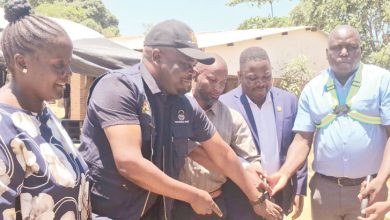
Minister of Health and Sanitation Madalitso Chidumu-Baloyi on Saturday went undercover at Bwaila Hospital in Lilongwe where she experienced first-hand bribery and disregard for patients’ privacy among some health care workers.
Posing as Mercy Banda from Area 36 in the capital city, the minister, clad in a head gear, floral blouse and wrapper cloth (chitenje) looked just like any ordinary patient as she queued to get her turn for assistance. She was accompanied by Ministry of Health and Sanitation director of creative and rehabilitation services Dr. Frank Sinyiza.
In an interview yesterday, Baloyi said she witnessed money changing hands, some health care workers shouting at patients and several patients doing consultations at once in total disregard for privacy.
She said being the eve of the International Women’s Day commemoration on March 8, she decided to experience life of a woman and all other patients at Bwaila Hospital.
For three hours, Baloyi said she endured the long queues at the facility and noted that while other health care workers performed their duties well, there were “a few bad apples” that demanded money from patients to be assisted quickly.
Narrated the minister: “I noted some clinicians receiving money from patients so that they are assisted faster. We experienced this as one of us was asked to pay K10 000 and indeed got assisted within 20 minutes.
“The cartel begins with security guards and clinicians. One clinician actually said the hospital was not testing malaria, yet the one who paid money was tested for malaria.”
The minister’s undercover raid followed President Peter Mutharika’s Executive order against corruption and bribery in the health sector after a joint investigation by local media houses exposed that bribery was rife in public hospitals.
Out patients at Bwaila Hospital are given numbers upon arrival. The minister, who was given card number 205, commended the arrangement, but noted that clinicians later disturbed the queue by giving priority to those who paid some money.
Baloyi said one clinician (name withheld) kept shouting at patients, complaining about emergencies coming in at 12.30pm or after that because it was closing time.
She said: “There is also lack of privacy. Imagine they sent seven of us at once into a doctor’s room. How do you explain explicitly your problem in the presence of all these people?
“That clinician openly told the patients ‘mudikire kaye ndithandize uyu’[pointing at another patient] because he is related to a staff member. That’s lack of professionalism and discriminatory!”
In a separate interview, Lilongwe district director of health and sanitation services Dr. Wilson Ching’ani, under whose jurisdiction Bwaila Hospital falls, admitted that despite calls to end bribery and corruption and even after the President’s order, some workers were still deviant.
He said: “The minister was indeed at the facility from 9am to around 1pm and witnessed certain things. Bribery is uncalled for and with the Executive order, the expectation was that everyone would know that such things are prohibited.
“I must say that in addition to the Ombudsman, we have also engaged police, the Anti-Corruption Bureau [ACB] and other bodies to help us deal with these issues.”
Ching’ani said some workers are already answering cases in court relating to similar issues. He urged the community to help support law enforcement agencies on this.
“Some cases are stuck in court because people are failing to help police as witnesses, which is a setback in this drive,” he said.
Reacting to the development, health rights activist Maziko Matemba commended the minister, saying monitoring enforcement of the order was key to realising its intended goals.
He said: “Knowing that we have an order because of cries from patients, the minister is doing well to check enforcement. It is upon her to ensure that things change, and the visits may also help her unearth new things.
“It is, however, concerning if patients fail or fear to act as witnesses in cases that are in court. The only way to bring these vices to an end is to testify, otherwise chickening out weakens all efforts to deal with these cases.”
Meanwhile, Baloyi has said government will continue to invest in health centres to help decongest main hospitals, but also that such visits are aimed at enforcing implementation of the Executive order.
She stressed that the government is committed to bring in affirmative action to ensure access to quality and dignified care to all Malawians as per the Health Sector Strategic Plan III and the Universal Health Coverage.
Mutharika ordered that there should be no soliciting of money from patients and barred public health facilities employees from owning, operating or holding shares in a private health clinic or pharmacy.
However, his second directive was met with resistance from the health care workers who, among others, argue that it infringes on their right of economic activities.
The ACB has since announced several measures to tackle corruption in public hospitals.
ACB acting director general Gabriel Chembezi on Tuesday issued a statement directing institutional integrity committees in public hospitals to undertake corruption risk assessments and integrity training for their staff members within six months.