Malawi has witnessed the mushrooming of civic education institutions, but the National Initiative for Civic Education (Nice).
The public trust remains a leader in building an informed nation and citizens’ participation in making democracy work.
Since its inception in February 1999, Nice has attracted the attention of governments and like-minded institutions across the continent.
Recently, GIZ Support to Good Governance (S2GG) in Ethiopia Programme dispatched two teams to learn how Nice keeps Malawians informed about democracy and development affairs.
The Government of Malawi, with support from GIZ, established the initiative for the sustained provision of civic education in the country.
By 1999, stocktakes of the six-year-old democracy revealed that most civil society organisations were concentrating civic education in urban and semi-urban settings, excluding the country’s rural majority.
Besides, the civic education providers were largely event-based, uncoordinated and politically biased, calling for an independent institution to avert looming voter apathy in the 199 Parliamentary and Presidential Election.
The stocktakes included a nationwide study by historian Professor Wiseman Chijere Chirwa and German governance expert Roman Poeschke, titled the Challenge of Democracy in Malawi: Socio-anthropological Conditions.
The insights gave rise to the initiative, now a public trust, with offices and agents in all 28 districts.
Nice boasts a vibrant network of volunteers who provide a bridge between district offices and far-flung communities.
It enjoys public confidence and trust due to its non-partisan stance and proximity to those who need its services to make informed decisions.
The trust empowers citizens to participate in public life and demand accountability from duty-bearers, which nags some political elites.
Lessons from Ghana
Nice is partially modelled on the non-partisan Ghanaian National Commission for Civic Education (NCCE), established by a 1993 Act of Parliament in compliance with Article 231 of that country’s Constitution.
NCCE promotes democracy, making Ghanaians aware of their rights and duties through civic education.
The model obligates government to fund civic education of its people.
Nice enjoys government subvention, but not fully funded by the State. However, the current trajectory points towards the desired status.
Despite government funding, the trust is governed by an independent board of trustees nominated by the public under the professional scrutiny.
Sharing lessons
Building on its 25 years of experience, Nice has become a learning ground for similar institutions across southern Africa.
As early as November 2014, its presentation to development partners in Maseru moved civil society organisations in Lesotho to learn from the Nice model.
The encounter gave birth to the Participatory Initiative for Social Accountability (Pisa), a national civic education programme that raises Lesotho citizens’ awareness of governance issues.
Pisa promotes citizens’ participation in democratic and developmental processes through its collaborative methods.
Between 2017 and 2018, Nice Trust and Pisa exchanged staff and skills, a cross-pollination and learning point to share civic education techniques that help entrench democracy in changing times
The most recent learning tour, held in March 2026, involved five officials from S2GG in Ethiopia, the Coalition of CSOs for Elections and the National Election Board of Ethiopia.
The first GIZ-funded mission to Malawi arrived in July 2025 to appreciate the interface between the civic education institution and the Malawi Electoral Commission (MEC) ahead of the September 16 2025 General Election.
Among others, the mission was impressed with the reduced nomination fees for women, the youth and persons with disabilities.
They also commended MEC for timely accreditation of civic and voter education providers.
They also commended the country for reviewing electoral laws, dispute resolution mechanisms and wide consultations through the National Elections Consultative Forum.
Valuing collaboration and networking, both missions from Ethiopia met with representatives of the Catholic Commission for Justice and Peace under the Chisankho Watch programme, the Centre for Civil Society Strengthening (CSSS), Umodzi Community Development Organisation and the Federation of Disability Organisations in Malawi.
The delegation hailed Nice for building a nationwide network of volunteers, issue-based civic education that focuses on community needs, interactive engagement methods, culturally sensitive approaches and strong partnership with various actors.
Nice also organised a field trip for the visitors.
They visited Bembeke FM in Dedza and Radio Lilanguka in Mangochi to appreciate how Nice collaborate with community radio stations to share civic and voter education messages.
The broadcasters shared insights into the power power of radio in enhancing and advancing governance at the local level.
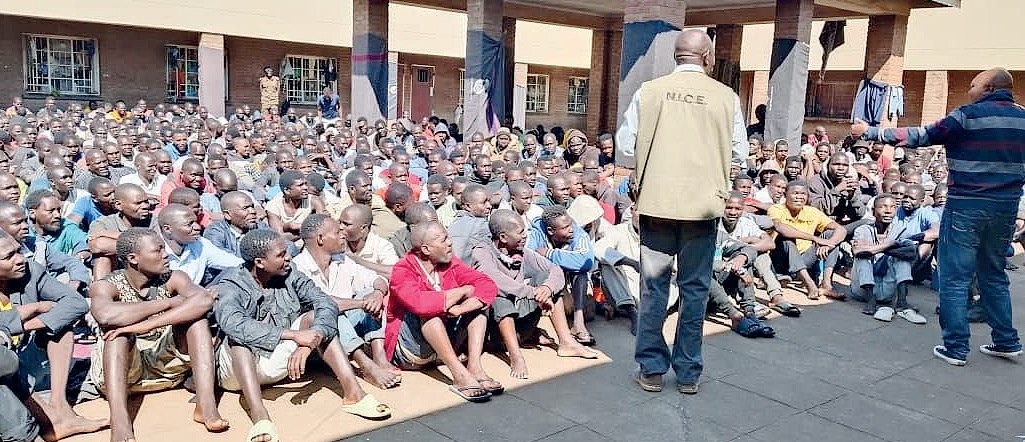
The recent team also visited Dedza Prison to experience how Nice volunteers disseminate information and deliver newspapers to the confined population.
This prison initiative recognise that every citizen, including those in incarceration, has a right to access information.
By reaching out to people often left behind, Nice uphold the rights of all citizens to stay informed about democratic processes.
Last July, the visitors interacted with some women who were aspiring to contest for parliamentary and local government seats in Salima under Nthawi Yawo, a four-district project co-implemented with CCSS with funding from the United Nations Development Programme.
The aspirants showcased the political leadership and manifesto development skills acquired under the programme.
The Mangochi-bound team attended a church session where a Nice volunteer was given the platform to make an announcement on the by-elections in Mikongo Ward.
The team that went to Dedza interacted up-close with aspiring parliamentary candidates from two parties who were battling for Dedza Mtakataka Constituency seat.
The author is a seasoned civic education specialist. He works with Nice Public Trust as the civic education programmes officer.