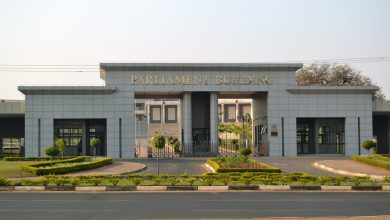
Parliament has kept a tight lid on the financing and rationale of having newly-appointed members of Parliamentary Service Commission (PSC) undergoing a leadership development programme in South Africa amid austerity measures.
The commission comprises five legislators, namely Chifundo Makande of Democratic Progressive Party, Daniel Chitonya representing Malawi Congress Party, Penjani Kalua of UTM Party, Ismail Mkumba of United Democratic Front and People’s Party representative Beatrice Mwale.

Suleman.
It is chaired by Speaker of Parliament Sameer Suleman, who is among the delegation.
The Nation could, however, not independently verify the exact number of the delegation, apart from Suleman and the commissioners.
Parliament posted on its official Facebook page on Tuesday that the Leadership Development Programme, which is set to end on Saturday, started with a two-day foundation course from Thursday last week.
The report said the programme is being hosted by the Southern Africa Development Institute, an institution which simply provides corporate training services, including short courses to both the public and private sector.
Both Suleman and Parliament spokesperson Ian Mwenye did not respond to our questionnaire seeking to get clarification on the funding of the programme.
However, some insiders indicated that the United Nations Development Programme (UNDP) may have financed the trip, an assertion later disputed by an official at the UN agency.
“While UNDP continues to support Parliament in various institutional strengthening and governance initiatives, this particular activity was not financed under any UNDP programme,” explained the official while referring The Nation back to Parliament.
The post about the training on Parliament’s Facebook page has drawn queries from Malawians on social media amid austerity measures the government introduced in November 2025 aimed at cutting expenditure and restoring fiscal discipline for the remainder of the 2025/26 fiscal year.
Among others, the austerity measures restricted foreign travel, with all trips requiring presidential approval through the Chief Secretary to the Government while delegation sizes were capped.
The austerity measures also entailed that donor-funded travel would not receive any government top-up allowances; hence, critics asking Parliament to justify the commission’s trip, including whether it was externally funded or not.
Commenting on the development, Human Rights Defenders Coalition chairperson Michael Kaiyatsa said holding a leadership development meeting abroad at a time when the government is urging austerity is hypocritical.
He said in the current economic climate, it is difficult to justify overseas meetings when similar objectives could be achieved locally or through more cost-effective means.
Kaiyatsa said such choices suggest that austerity is selectively applied rather than a genuine commitment to prudent public spending.
“The broader danger is the damage this does to public trust. Citizens are being asked to tighten their belts while parts of government appear insulated from the same sacrifices,” said Kaiyatsa.
Centre for Social Accountability and Transparency executive director Willy Kambwandira said in a separate interview that the trip lays bare a troubling contradiction at the heart of the government’s narrative.
He said: “It is unfortunate that institutions that were supposed to provide oversight in the implementation of the austerity measures are violating the same. This sends a damaging signal that austerity is more of a public relations slogan than a shared national sacrifice.”
In a written response, governance commentator Undule Mwakasungula said such policy inconsistencies create a perception of double standards and weakens public trust.
“If austerity is to be meaningful, it must apply to everyone, especially those entrusted with managing public resources,” he said. “Government must walk the talk as this is not what the DPP promised Malawians. This is a total departure from the promises.”
Leadership Institute for Transparency and Accountability executive director Goodwell Logeya on his part, said: “In such an environment, public institutions must demonstrate fiscal discipline, empathy and symbolic leadership. Sending commissioners abroad for training during austerity raises legitimate concerns.”