Picture this: Two young brothers, Enock Mzembe, and Kenson Mzembe aged 18 from Nagara in Karonga, were remanded to prison for one month for failure to pay K100 000 for bail, only to walk to freedom on February 2 2026, after being acquitted in the matter.
The two were jointly charged with burglary and theft. Court records who that one of the items alleged to have been stolen, a mobile phone, was said to have been recovered from a person who claimed to have purchased it from Enock Mzembe.
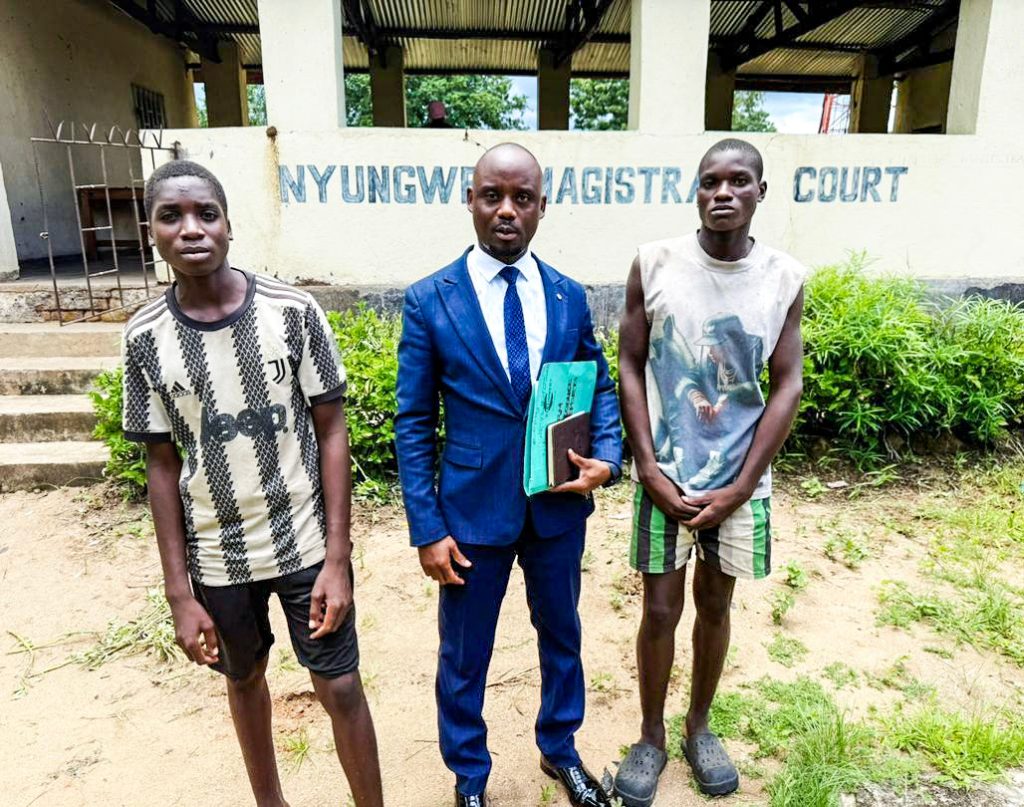
But in court, Enock said he had bought the phone from his brother, Kenson, who in turn indicated that he had purchased the cellphone from a stranger at a trading centre within their area.
But during trial, lawyer representing the two, Hardrod Zeru Mkandawire, who came in ongoing Nationwide Pro Bono Legal Services Scheme that Malawi Legal Aid Bureau is carrying out with the Malawi Law Society, noted that State tendered into evidence a mobile phone that was different from the one allegedly recovered.
As such, Second Magistrate Backfield Kalowekamo consequently dismissed the case and acquitted both accused persons, after staying on remand for a month as their parents were unable to raise the bail bond cash of K100,000 for each.
Sellina Gondwe, a mother of the two says, they couldn’t have raised the K200 000 because of their financial situation.
“We are poor, and raising that much could not have happened. We don’t have anything, not even livestock which we could have sold to raise those funds, and the situation just shows how without money, people, the poor like us suffer,” she says.
Lawyer Mkandawire says it is a regrettable development considering that ordinarily, criminal justice system is expected to serve every citizen equally, and, this is emphatic under the Constitution that all people regardless of their status, are equal under the law.
“It is obvious that if I had not stepped forward to represent the Mzembe brothers, they would still be in custody waiting for an opportunity to be admitted to bail, and, or could have been convicted and sentenced to serve a jail term.
Worse still, as we write, Malawi Prison Service spokesperson Charles Meke says Lilongwe Prison, popularly known as Maula, has about 40 people incarcerated due to failure to pay fine.
The situation mirrors a new paper on examination of monetary sanctions in Malawi’s criminal justice system which shows that the current legal framework criminalizes poverty, creating cycles of disadvantage that further entrench economic and social inequality.
It says in a country where a majority of the population lives below the poverty line, with high inflation and limited economic opportunities, the practice of imprisoning individuals for their inability to pay fines is particularly problematic.
Titled ‘Monetary Sanctions and Poverty in Malawi’s Criminal Justice System’ has been developed by Deputy Chairperson at the Industrial Relations Court Chikondi Mandala and Sarai Chisala Tempelhoff, Executive Director of the Gender Justice Unit.
In the paper, Mandala and Tempelhoff argue that monetary sanctions in Malawi disproportionately impact those living in poverty through multiple mechanisms.
It reads: “Courts frequently fail to assess defendants’ ability to pay before imposing fines; imprisonment becomes the default punishment for non-payment; property seizure targets the limited assets of poor households; and colonial-era vagrancy laws have historically criminalized the visible manifestations of poverty.
“These impacts are not merely incidental but structural features of the current system. Second, these practices indeed mirror historical systems of debtors’ prisons and peonage in troubling ways.”
It adds that when individuals are imprisoned not for their original offense but for inability to pay economic sanctions—as explicitly permitted under sections 331 and 333 of Malawi’s Criminal Procedure and Evidence Code—this recreates the essential feature of debtors’ prisons.
It adds that the cycle of increasing debt through additional fees, interest, and costs of imprisonment creates a form of modern peonage, where offenders become bound to the criminal justice system through financial obligations they cannot realistically discharge, much like historical labourers bound to service through manufactured debt.
It suggests: “Implementing comprehensive ability-to-pay assessments; developing alternative non-monetary sanctions for low-income offenders; capping total sanctions as a percentage of income; and eliminating additional fees and interest that compound initial penalties.”
Experts weigh in, suggest solutions
Programs Manager for Youth Watch Society, Edward Kantuseya whose institution follows up on such matters, says detention or prisons should be for worst or hard call criminals and subjecting an individual to detention or imprisonment because of poverty is not fair. Poverty is not a crime.
He says courts when mating out bail conditions and fines should among others look at the office and the capacity of the individual to honour such conditions.
“If necessary assess the economic capacity of an individual before conditions for bail are given. Where that was omitted or overlooked the court may review and waive the conditions.
“Otherwise this is why people say prisons are for poor people. Precisely Sustainable Development Goal 16.3.2 talks about reducing sentenced detainees globally. Prisons should be for worst and hard core offenders. Poverty is not a crime,” he states.
Executive Director of the Centre for Human Rights Education, Advice and Assistance (CHREAA) Victor Mhango says many of those incarcerated are first-time or low-risk offenders, often charged with minor or non-violent crimes.
“Conditions for such inmates are often indistinguishable from those serving custodial sentences: overcrowding, limited access to healthcare, disrupted family ties, and loss of livelihoods.
“Because their detention is technically ‘avoidable’ through payment, they may also fall through gaps in legal aid, case prioritisation, and review mechanisms, leading to unnecessarily prolonged remand periods,” he said.
He adds that short periods of incarceration can result in loss of employment, eviction, school dropouts for children, and long-term indebtedness with families being be forced to sell productive assets to raise bail or fines, further pushing them into poverty.
National Advocacy Platform (NAP) chairperson Benedicto Kondowe, says cases from Maula and Karonga show how people can lose weeks or months of freedom not because they are guilty, but because they are poor.
Kondowe, a private practice lawyer argues that the practice offends the Constitution’s guarantees of equality before the law, personal liberty, and the presumption of innocence.
“It effectively turns pre-trial liberty into a privilege for the wealthy, deepening inequality and eroding confidence in the criminal justice system as a fair arbiter,” he said.
Kondowe urges courts to prioritise non-custodial sentences, community service, and fines assessed on ability to pay, adding that bail decisions should be risk-based rather than cash-based.
On his part, Centre for Human Rights and Rehabilitation (CHRR) executive director Michael Kaiyatsa said when people are jailed simply because they cannot pay, the justice system ends up punishing poverty rather than wrongdoing.
“This deepens poverty, as time in prison leads to loss of income, broken families, and long-term social and economic hardship. Legal aid services also need to be strengthened so that poor and vulnerable people are protected from unnecessary detention,” he suggested.
In Malawi, the paper says that economic sanctions in Malawi primarily take three forms being fines imposed for many offenses, Court fees and Restitution ordered to compensate victims of crimes.