Malawi’s rising cost of living is beginning to shift households spending patterns, with consumers cutting back on perceived luxuries while prioritising basic needs, Business News analysis has established.
The Centre for Social Concern (CfSC) Basic Needs Basket for an average urban family of six now exceeds K1.1 million per month, which is well above the earnings of most households and the minimum wage. Fixed incomes and rising expenses have left many households in turmoil.
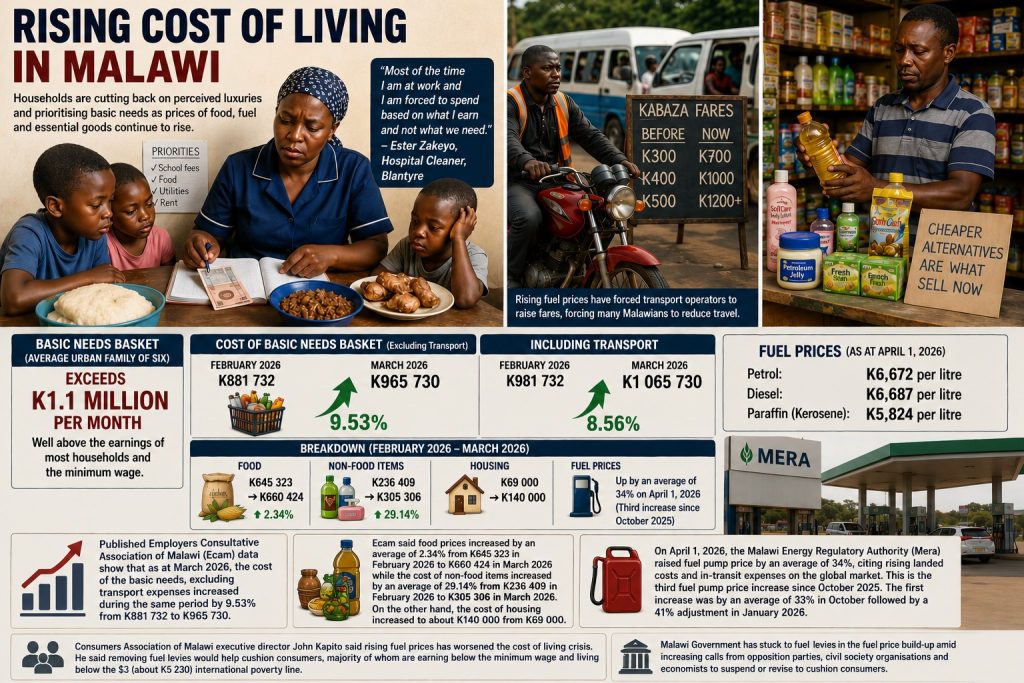
For Ester Zakeyo, a 40-year-old cleaner at a public hospital in Blantyre, earning about K300 000 per month has offered little room for adjustment, forcing her to cut expenditure on goods once regarded as essentials.
With three children to support, her spending is concentrated on school-related needs, basic utilities and food, with expensive protein sources such as beef replaced by cheaper alternatives such as chicken portions.
Unlike informal workers who can diversify income streams, Zakeyo’s formal job gives little room for side businesses.
She said: “Most of the time I am at work and I am forced to spend based on what I earn and not what we need.”
Speaking separately, 35-year-old kabaza operator Hamanson Chikwiri said that while he operates in a flexible income environment, his business is disrupted by rising fuel prices and scarcity.
He observed that fuel price increases have forced transport operators to raise fares significantly, with some routes now costing more than double previous rates. He added that higher prices are now forcing customers to use lesser kabaza services.
A mini-shop operator in Blantyre Vincent Moses said what is selling now are cheaper alternatives to well-known brands for body lotions, baby petroleum jelly, soap and cooking oil.
Published Employers Consultative Association of Malawi (Ecam) data show that as at March 2026, the cost of the basic needs, excluding transport expenses increased during the same period by 9.53 percent from K881 732 to K965 730.
When transport is factored in, the total cost of living has increased by 8.56 percent from K981 732 to K1 065 730.
Ecam said food prices increased by an average of 2.34 percent from K645 323 in February 2026 to K660 424 in March 2026 while the cost of non-food items increased by an average of 29.14 percent from K236 409 in February 2026 to K305 306 in March 2026.
On the other hand, the cost of housing increased to about K140 000 from K69 000.
Fuel prices have also been on the rise. On April 1, the Malawi Energy Regulatory Authority (Mera) raised fuel pump price by an average of 34 percent, citing rising landed costs and in-transit expenses on the global market.
This is the third fuel pump price increase since October 2025. The first increase was by an average of 33 percent in October followed by a 41 percent adjustment in January this year.
Consumers Association of Malawi executive director John Kapito said rising fuel prices has worsened the cost of living crisis.
He said removing fuel levies would help cushion consumers, majority of whom are earning below the minimum wage and living below the $3 (about K5 230) international poverty line.
“Subsidies on any government services are in the end paid by the very same consumer because the Malawi economy has weak sources of revenue generation and the consumer becomes the target,” he said.
Malawi Government has stuck to fuel levies in the fuel price build-up amid increasing calls from opposition parties, civil society organisations and economists to suspend or revise to cushion consumers.