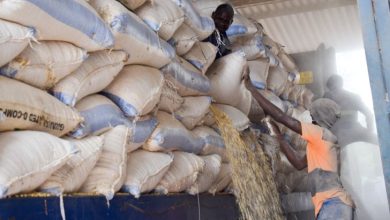
Maize prices are yet again on an upward spiral after a slight ease during harvest season with a 50 kilogramme (kg) bag now fetching K85 000, squeezing low-income earners in a tight corner.
For consumers such as Anita Kang’ona of Mthandizi in Bangwe Township, Blantyre the rising prices have forced her family to take a drastic measure of having one meal per day.

The 26-year-old housewife, married to smallscale entrepreneur James Kumdanila, said her family’s food situations was worsening with each passing day.
“The maize price increase has hit us hard. We are buying maize at K1 600 per kilogramme and we cannot afford to three meals per day, we have resorted to be taking one meal per day,” said Kang’ona during an interview at a local maize mill.
She said the food situation has reduced her family to almost beggars as her husband’s business has virtually collapsed due an increase in prices of Irish potatoes, a key ingredient in making fries.
“So this [2 kg] maize flour will take us up to six days, but under normal circumstances, it should be enough for just for two days,” said Kang’ona.
Her situation is similar to that of Doreen John of Gomani Village, Traditional Authority Likoswe in Chiradzulu. Her rural setting borders Bangwe Township in Blantyre.
In an interview, she said in the 2024/25 agricultural season, she harvested only a 50kg bag of maize and consumed it in March this year.
“Only God knows where we are heading to, we will survive by God’s grace,” said John who survives on selling firewood.
The Nation checks in some parts of the country last week established that a 50kg bag of maize has hit as high as K85 000.
In Gomani Village in Chiradzulu, vendors were found selling maize at K1 700 per kg, translating to K85 000 per 50kg bag. On the other hand, in Kauma, Lilongwe a 50kg bag of maize was selling between K62 000 and K68 000.
International Food Policy Research Institute (Ifpri), in its report for July 2025, said maize prices have gone up by about 13 percent in most parts of the country.
The report said in July 2025, the average maize price was K1 1 69 per kg from K1 000 in June while in July last year, average maize prices were K792 per kg.
In June, Ifpri reported that maize prices jumped eight percent from K952 per kg or K47 600 per 50kg bag to K1 031 per kg or K51 550 per 50kg bag. This increase was moderate compared to the same period last year when the staple grain rose by 23 percent from K612 per kg or K30 600 per 50kg bag to K753 per kg or K37 650 per 50kg bag.
Economists have since called for timely intervention to control rising maize prices, warning that any price surge risks exerting more inflationary pressures in an economy already exposed to election-induced spending.
Lilongwe University of Agriculture and Natural Resources agriculture economist Horace Phiri, in an interview, noted that several factors have contributed to the current maize price upsurge. These include the government’s farm gate price and the general rise in the cost of goods and services.
He said: “It is not time to worry yet because we are comparing the kwacha that has different value in the sense that what it used to buy last year will not buy the same now.
“So, if you look at the [maize] price, it is a bit higher, but now if you look at the real value of the money, it may as well be less because everything has gone up then it’s natural that we expect the maize prices also to go up as well.”
However, Phiri urged government to ensure that there is enough maize supply on the market by ensuring that Admarc Limited starts selling the staple grain as soon as possible.
In a separate interview, Admarc spokesperson Theresa Chapulapula said currently the State produce trader’s priority is to continue purchasing produce from smallholder farmers. She said to date Admarc has purchased about 13 000 metric tonnes (MT) of maize.
“The opening of sales markets is guided by the Ministry of Agriculture, based on assessments of needs and vulnerabilities and various reports that inform the food situation on the ground,”she said.
Meanwhile, the World Food Programme (WFP) is preparing to support 1.9 million of the country’s estimated 6.8 million most vulnerable people. WFP is targeting nine districts.
WFP Malawi country director Hyoung-Joon Lim said the interventions will include food assistance for 1.7 million people, nutrition support for over 110 000 vulnerable individuals, emergency school meals for 87 500 learners, and logistics support to help the government move maize from Strategic Grain Reserves to remote communities.
Targeting will focus on districts with the highest food insecurity and malnutrition rates, particularly in the Southern Region, where maize prices are rising.
In an earlier interview, University of Malawi associate professor of economics Gowokani Chijere Chirwa observed that maize prices directly drive inflation, adding that when grain prices increase, prices of other commodities also rise.
Maize as part of the food component, accounts for about 53.7 percent in the consumer price index, an aggregate basket for computing inflation. This means that any movement in the price of maize either way has a bearing on the cost of food.
Minister of Agriculture Sam Kawale earlier told The Nation that the government is investing heavily in irrigation farming, promoting crop diversification and providing resources for local procurement of maize to fill the food deficit.
WFP reported that Malawi’s maize deficit had widened to 1.2 million MT from the initially projected 537 380MT in the 2024/25 growing season.