Government is caught between demolishing illegal structures in road reserves and paying out billions in compensation—a decision that will test its commitment to the law.
Section 10 (6) of the Public Roads Act outlaws construction, alteration, cultivation or tree planting within 30 metres of the road boundary.
In an interview this week, Minister of Transport and Public Works Jappie Mhango described the continued encroachment on road reserve land as one of the biggest obstacles to the implementation of road rehabilitation projects, arguing that government is being compelled to
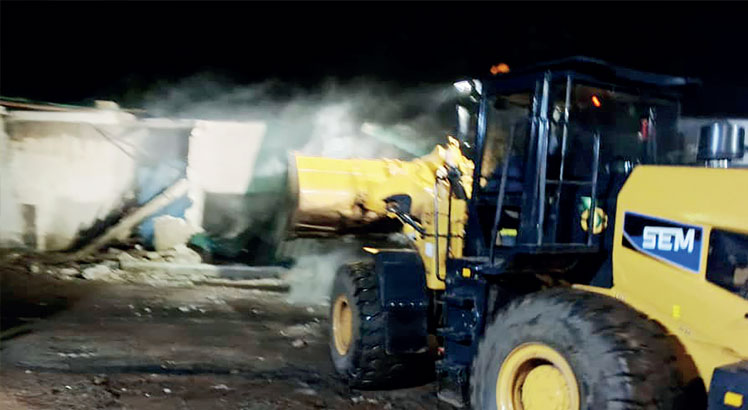
structures in Area 1,
Lilongwe. | Nation
compensate people who, by law, should not be entitled to any payment.
He attributed the problem partly to financing conditions imposed by development partners , saying some donors require government to compensate occupants of road reserve areas before rehabilitation works begin.
But the minister could not immediately provide the cumulative amount spent compensating road encroachers for the past five years.
Said Mhango: “The law is very clear that road reserve area is 30 metres from the road and anyone developing within that area should not receive any compensation because ignorance of the law is not a defence.
“But donors funding these road rehabilitation projects are giving us problems. They make compensation a condition before commencement of the project, which is very sad. We are ending up compensating irregularities.”
He said government plans to engage major financiers of Malawi’s road infrastructure, including the World Bank, African Development Bank, European Union and Opec Fund for International Development to explore whether funding conditions can be reviewed so that compensation is not extended to illegal developments within protected road reserves.
The Nation spot-check last weekend established that road reserve encroachment is common along major roads in the country.
Between Liwonde in Machinga and Matawale in Zomba where rehabilitation works supported by World Bank began earlier this month, the M3 reserve is dotted with numerous houses, shops and other permanent structures despite the presence of officially demarcated road reserve beacons.
The situation is also similar along the M1, particularly around Lizulu in Ntcheu, Chimbiya in Dedza and Bowe in Kasungu.
Beyond the legal implications, the continued occupation of road reserve l and has significant financial and operational consequences.
Malawi Building , Civil Engineering and Allied Trades Association (Mabcata) vice-president Kondwani Kadango said compensation has become one of the major cost drivers in road rehabilitation projects.
He said apar t f rom escalating project costs, compensation disrupts project planning and delays completion schedules.
“I think government should take a bold step to ensure that individuals who
develop on road reserve areas are not compensated. Government should come up with a policy that gives contractors powers to demolish structures constructed within road reserve areas. This is draining public resources ,” said Kadango.
Roads Fund Administration spokesperson Masauko Mngwaluko on Tuesday asked for more time to provide updated figures on how much government has spent compensating people affected by road projects over the past five years.
Previously, he disclosed that between 2013 and 2017 alone, government paid more than K4 billion in compensation to people affected by road construction and rehabilitation projects.
The figures show that K962.7 million was paid in 2013, K387.7 million in 2014, K834.5 million in 2015, K774.4 million in 2016 and K869.6 million in 2017.
The historical payments suggest that compensation has remained a significant expenditure in road development , raising questions about the effectiveness of enforcement mechanisms designed to protect road reserve land from illegal occupation.