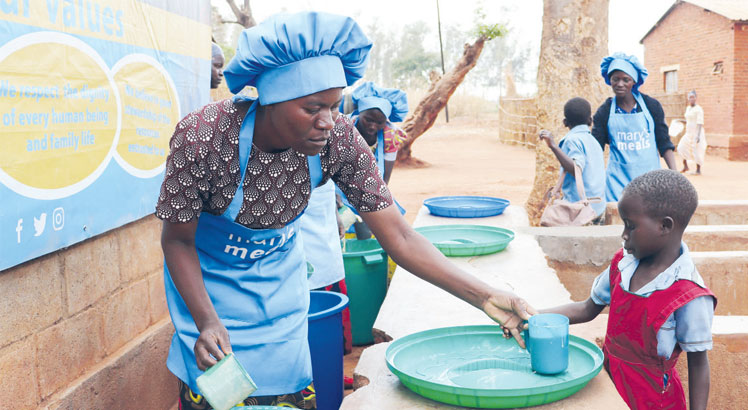
Over 600 000 primary school children face the prospect of going without meals when the new school term begins, after the World Food Programme (WFP) announced that funding for its school feeding programme will run out from September 2026.
The looming disruption threatens to reverse hard‑won gains in nutrition, enrolment, and retention, exposing vulnerable learners to hunger and harmful coping strategies such as child labour and early marriage.
In its August 2026 Country Brief, WFP Malawi said the shortfall puts nutrition and education gains at risk.
“The Government of Malawi and partners continue to prioritise school feeding to protect children’s nutrition and education outcomes. However, funding shortfalls threaten programme continuity, with 611 800 learners at risk of losing school meals from September 2026,” the brief signed by WFP country director Hyoung-Joon Lim reads.
“Disruption during the lean season could increase absenteeism and expose children to harmful coping strategies, including child labour and early marriage. Urgent donor support is required to sustain school meals and protect gains in education, nutrition and human capital development.”
WFP says $19.7 million, about K34.1 billion, is needed to sustain the programme beyond September 2026.
The government school feeding programme is currently running in 2 647 out of 5 979 public primary schools, representing 44 percent coverage.
The remaining 56 percent, or 3 332 schools, are not yet covered. Government aims to achieve universal coverage by 2030.
According to the latest data, Mary’s Meals and WFP are the two largest providers. Mary’s Meals supports 1 071 schools while WFP supports 784 schools.
In Nsanje, a district hit repeatedly by floods and dry spells, Nyamadzere Primary School head teacher Christopher Mafunga said the programme has transformed attendance and retention.
Enrolment rose from 2 600 in 2024 to 3 014 in 2025, with no dropouts recorded between the two years.
“We are at the receiving end of most climatic shocks. Hunger is usually prevalent here in Nsanje. But through the school feeding programme, we have managed to keep learners in school,” Mafunga said in a phone interview.
“Learners come to school as early as 6am. My plea is that this programme should continue because, on top of improving enrolment, it is also working for the good of nutrition. Nsanje has had high rates of malnutrition over the years.”
Civil Society Education Coalition (CSEC) executive director Benedicto Kondowe said independent assessments show school feeding has a clear positive effect on enrolment, especially in rural and food-insecure areas.
“While government’s ambition of achieving universal school feeding coverage by 2030 is commendable, it will remain unrealistic without a clear and sustainable financing model,” he said.
“Malawi must move from treating school feeding as a donor-supported intervention to recognising it as a strategic national investment in human capital, food security and the future productivity of its children. Achieving universal coverage will require significant investment, predictable budget allocations, stronger partnerships and integration with local agricultural production.”
Director of Inclusive Education and School Health and Nutrition in the Ministry of Education, Science and Technology, Virginia Kachigunda, acknowledged that WFP is a key partner covering a significant number of schools.
She said the decision may affect the programme but government is exploring alternative ways to keep it running.
Kachigunda referred further questions on alternative funding to School Feeding Programme National coordinator Albert Saka, who asked for more time to respond.
In the previous academic year, 17 partners supported school feeding across the country.
These included Afikepo covering 13 schools, Care Malawi 19 schools, GIZ 3 schools, Malawi Government 106 schools, community members 267 schools and HarvestPlus 92 schools.
With the new term approaching, education and nutrition stakeholders say the immediate priority is bridging the $19.7 million gap to ensure the 611 800 learners currently supported by WFP do not lose their daily meal.