Justin Jonas, 47, sits under a makeshift shed in Limbe, his right foot pressing the pedal of his sewing machine as a needle sews a pair of trousers. He pulls the fabric towards him, checks the seam and continues stitching.
Next to him, another tailor, Yamikani Matewere does the same. He removes loose threads as customers wait with second-hand clothes that need tightening, shortening or repair.
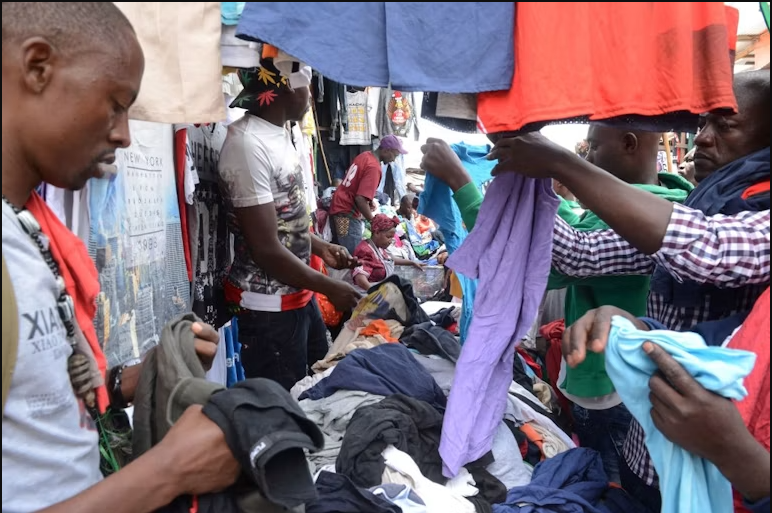
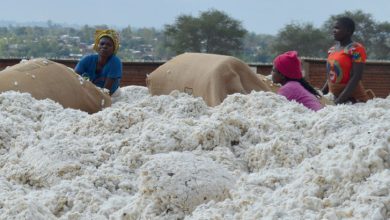
The tailors are part of an informal chain giving imported second-hand clothes a new lease of life in Malawi, where the appetite for imported used clothes has well and truly smothered the local cotton production and textile industry over the past four decades.
But near their shed at the heart of Blantyre’s busiest market, discarded textiles and plastic-laden waste clog drainage channels, leaving stagnant water where mosquitoes breed.
The clothes come from the second-hand market in Limbe. Their needles make them fit the new owners.
“This is what I do daily. I measure, cut and stitch clothes bought from the second-hand market, giving them another chance to be worn,” says Jonas, his foot still doing what it does best on the pedal.
Born in 1979 in Getu Village, Traditional Authority Chiwalo, Machinga, he learned tailoring there and started the trade in 1999 before moving to Blantyre two years later. He now lives in ManaseTownship south of Blantyre central business district.
On average, he makes K15 000 from mending clothes from overseas, especially Europe, US and China. Market days—Mondays, Wednesdays and Fridays—bring more customers and better earnings.
“There are more people coming with clothes that need to be adjusted,” Jonas says.
The trade provides him with a livelihood, but his experience also raises questions about what Malawi wears and what it makes.
Jonas says he used to make work suits and dresses using garments bought from Pound Shop in Limbe, which has since closed.
In 2007, he travelled to Cape Town in South Africa, where he worked for Sir Dicks, a textile company that produced police uniforms.
“This company gave me a lot of experience in tailoring. We were producing and assembling police and nurses’ uniforms,” says the tailor.
The experience showed him what garment production can offer beyond clothes themselves—employment and a market for people with skills such as his.
That is why Malawi’s dependence on imported clothing troubles him.
“You wonder if ever this will come in Malawi, where government would give the local [industry] an opportunity to produce their wear,” he says.
The contradiction is visible around him.
Malawians buy clothes brought into the country, while tailors such as Jonas earn a living by altering them to fit.
In 2023, Malawi spent roughly $100 million to $112 million (about K173 billion to K194 billion at the current exchange rate) reported clothing imports, with secondhand clothes accounting fora lion’s share.
Used clothing alone was valued at about $99.2 million (about K172 billion) in the main reported category. The Observatory of Economic Complexity puts the figure at $92.5 million (about K160 billion) because of differences in trade classifications.
The figures point to a significant outflow of foreign exchange on clothing at a time when Malawi struggles with forex scarcity, youth unemployment amid the collapse of its cotton and textile industry.
Economist Christopher Mbukwa, from Mzuzu University, says the influx of secondhand clothes is making it harder for Malawi’s textile and garment industry to develop.
He says Malawi produces cotton but has limited capacity to turn it into competitive fabrics and affordable finished garments.
“Our textile and garment value chain is fragile. Malawi produces cotton but has limited capacity to turn it competitively into fabric and affordable finished garments. With the influx of second-hand clothes, our domestic textile and garment industry cannot grow,” he says.
The result, Mbukwa says, is a weak value chain in which Malawi produces some of the raw material but struggles to capture more value from processing, manufacturing and selling finished garments.
However, the incoming bales of used clothes, which many Malawians find affordable, stylish and more durable, also choke the potential of Malawi’s population of over 22 million as the workforce and market for industries that used to employ many.
Economists warn that the country is exporting jobs and forex amid stinging youth unemployment, forex shortage and shrinking cotton industry.