The Bankers Association of Malawi (BAM), a grouping of seven commercial banks, says the country’s banking sector is responding to the growing demand for digital services through innovation and partnerships.
BAM chief executive officer Lyness Nkungula said this in an interview on Friday in response to the World Bank’s Global Findex 2025 Report, which indicates that only 50 percent of Malawian adults had a financial account in 2024, which is lower than the sub-Saharan African average of 55 percent and the global average of 76 percent.
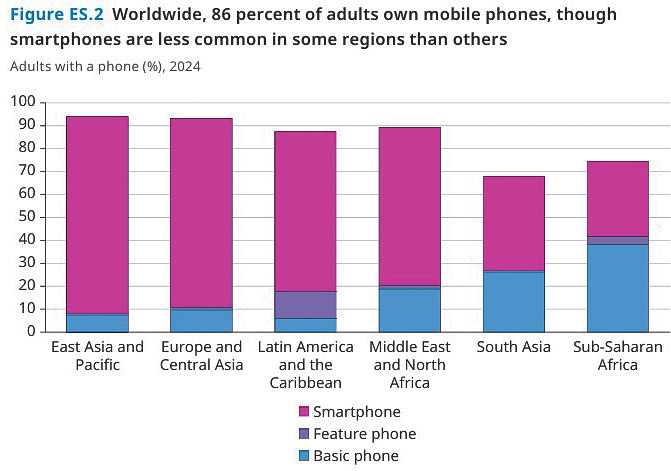
The World Bank report shows that the growth is largely driven by digital payments and mobile money, particularly in sub-Saharan Africa.
Nkungula said most banks now offer mobile banking Apps, USSD services and Internet banking platforms to boost financial inclusion and access.
“Integration with the National Switch has enabled wallet-to-bank and bank-to-wallet transfers, while agent banking is extending services to remote areas,” she said, adding that banks are also working to increase account ownership by introducing low-cost accounts and simplifying onboarding,” said Nkungula.
But she said reaching rural populations remains challenging for digitalisation due to poor network coverage, electricity shortages, high delivery costs and cultural barriers that continue to hinder outreach.
The Global Findex 2025 Report also notes that 61 percent of adults in low and middle-income economies made or received a digital payment in 2024 while 42 percent made digital merchant payments, up from 35 percent in 2021.
Economist and International Trade Council board member Paul Kwengwere said on Friday that Malawi has made strides in financial inclusion, with mobile money bringing financial services closer to people.
“However, challenges such as low digital literacy, socio-cultural barriers and the lack of tailored products for farmers and small businesses remain,” he said.
University of Malawi lecturer and financial inclusion expert George Jawali said in an interview that while there is progress, gaps remain in community engagement.
He said: “There have been improvements, particularly in the spread of cashing outlets for Airtel Money and TNM Mpamba.
“However, financial institutions often shy away from openly seeking the public’s views on how they can improve and achieve full inclusion.”
Jawali said there is a need for more inclusive approaches, adding that there is need to implement measures to include people with various disabilities.
The Global Findex Report indicates that mobile money is now a key driver of formal savings, with 23 percent of adults in sub-Saharan Africa saving through mobile money accounts, a 10 percentage point increase since 2021.