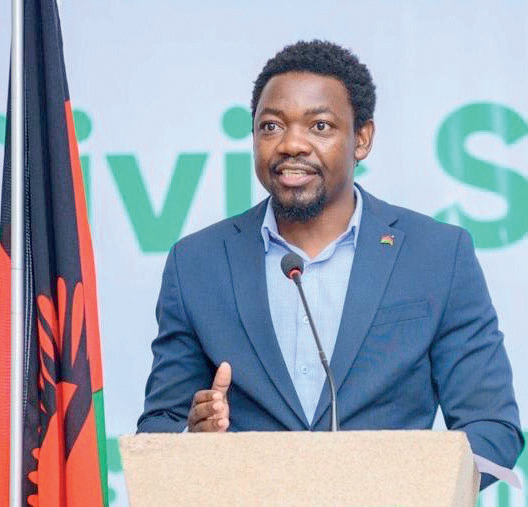
The United States of America recently imposed tough new restrictions on Malawian travellers, including a $15 000 bond for those applying for B1/B2 visas and stricter scrutiny for students. The measures have sparked outrage among Malawians, who see them as unfair and exclusionary. Weekend Nation spoke with Youth and Society (YAS) executive director Charles Kajoloweka to understand what these restrictions mean for young Malawians, the future of education, and Malawi’s global partnerships.
It is a door
slammed shut.
‘This is not a
bond, it’s a ban’
Q1. The visa bond requirement came into effect on August 20. Is it too early to tell how much inconvenience Malawian travellers, especially students, are facing?
A1. Yes, it is early, but the fear and uncertainty are already palpable. Even before the first applications are processed under the new rules, we are receiving messages from worried families. Some students who were due to travel in the coming weeks are in tears because they know their chances of raising such a bond are non-existent. One student told me bluntly, “This is not a bond; it is a ban.” So, while we may not yet have the full scale of cases, t h e chilling effect is immediate—people are already abandoning their dreams before they even apply.
Q2 What does it mean when these hard-won opportunities, especially for students, are blocked by financial barriers like this bond?
A2 It is devastating. Scholarships are not just personal achievements; they are communal triumphs. Families, schools, and communities rally behind one student, sometimes selling assets just to cover travel costs. When a $15 000 bond is suddenly required, the opportunity vanishes overnight. These students did everything right— they competed, excelled, and earned their place. To then be locked out for reasons beyond their control is crushing, both for the individual and the community that invested in them.
Q3To put this in perspective for an American policymaker, what does a $15 000 bond mean to an average Malawian family?
A3 It is an impossible s u m . Ma l a w i is one of the poorest countries in the world, where most citizens live on less than $2 a day. For a rural farmer, this bond is equivalent to three decades of income. It is like telling an American family earning $50 000 a year that their child can only study abroad if they put up $1.5 million. This is not a deterrent against visa overstays—it is a door slammed shut.
Q4How might this policy affect Malawi’s education pipeline and the country’s ability to develop skilled professionals?
A4The impact will be dire. Malawi already struggles with limited capacity in specialised fields such as medicine, engineering, and technology. We rely on students going abroad to fill those gaps. If Amer i c a , one of the world’s top destinations for higher education, b e c o m e s inaccessible, our pipeline of skilled professionals shrinks dramatically. This will slow down national development and keep us trapped in cycles of underdevelopment.
Q5Do you see this policy deepening inequality among young Malawians, where only the wealthy can dream of studying abroad?
A5. Absolutely. This bond essentially says education abroad is for the privileged few. The poor but brilliant student is excluded, while a wealthy but average student may find a way through. Education should level the playing-field, but this measure tilts it even further towards inequality. It entrenches privilege and punishes talent born in poverty.
Q6 What does the loss of US educational opportunities mean for the aspirations of Malawian youth and the country’s global future?
A6 For our young people, America has long represented hope—its universities, its leadership programmes, its openness to the world. If that door closes, it signals to Malawian youth that their dreams are disposable. Over time, this could also shift Malawi’s global alignments. If the US pushes us away, our students will turn to China, the UK, or elsewhere. That means the next generation of Malawian leaders may grow up shaped by different powers, and America risks losing influence in Africa. This bond, therefore, is not just about visas— it is about the soul of future partnerships