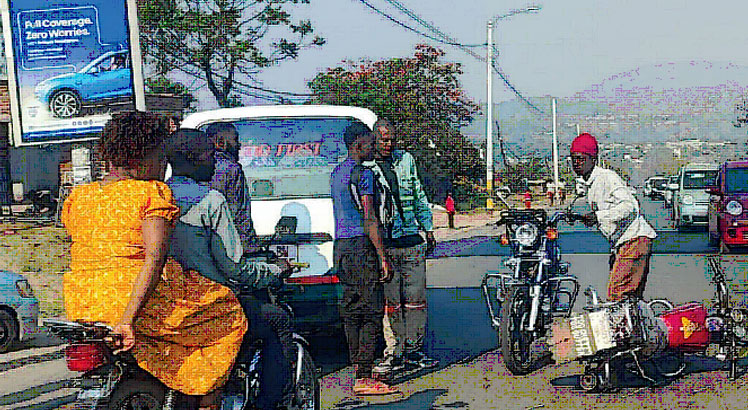
0n a busy morning in Lilongwe’s bustling streets, the growl of motorcycle engines fills the air.
In the swarm of kabaza riders dangerously weaving past a jam of minibuses and saloons is Chimwemwe Mbale, 29, who operates from Senti in Area 18.
Clad in a worn-out reflector jacket and soiled crash helmet, his daily routine is a gamble with life—perilously balancing between survival and tragedy.
Motorcycle taxis like his have become a trusted mode of transport and economic lifeline for many Malawians. Cheap, fast, and convenient, they ferry thousands of commuters daily, especially in rural areas and clustered urban settlements with neglected roads.
However, behind the booming business lies a quiet desperation: most riders, often young men with no formal jobs, are risking their lives to put food on the table, but they get too little to survive.
“I know it’s risky,” Mbale sighs, wiping sweat from his forehead after dropping off a passenger. “The roads are bad, accidents happen all the time. But without this bike, my children would sleep hungry.”
The feared carnage is well-documented, with the largest hospitals in Blantyre and Lilongwe setting aside special wards for fractured survivors of motorcycle-related accidents.
However, for many riders like Mbale, the struggle does not end with dodging reckless drivers, bumps and potholes.
The motorcycles they ride belong to wealthier owners who hire them out on slavish terms.
Most riders are required to hand over the daily earnings to the owner, only being allowed to keep what they earn from late-night shifts and on Sundays. Few get a fixed weekly or monthly pay, regardless of business climate.
“It’s like working for someone else’s stomach,” says Gift Nyanja 22, from Area 23 in the capital city. “Every kwacha I make from morning till dusk goes to the boss. I only start earning for myself after dark, when I’m too exhausted to ride safely on our dangerous roads.”
Night shifts expose riders to violent robberies, drunken passengers and fatal crashes on poorly lit roads.
Yet without their own motorcycles, they have no bargaining power.
“If you fail to meet the weekly payment, the owner snatches the motorbike away,” Gift explains. “That means your children don’t eat. So you keep slaving.”
Some riders have to surrender K10 000 to K12 000 to their bosses daily, only allowed to keep the day’s earnings on Sunday.
The monthly minimum wage—K126 000—prescribed and enforced by the Ministry of Labour—scarcely applies to the riders who keep the nation on the wheels, with a majority risking their lives for almost K50 000 a month.
Their lamentation go beyond low pay and risky roads.
From their meagre pay, kabaza riders have to pay kickbacks to evade harassment, hefty fines and beatings from corrupt traffic police.
Some passengers refuse to pay and others rob them in the night, but quitting is rarely an option.
Malawi’s massive youth unemployment crisis has left thousands of young men trapped in this high-risk kabaza business.
A quarter of jobseekers, aged 18 to 35, cannot find employment, reports the International Labour Organisation.
“On a good day, I make K15 000 to K20 000 ferrying passengers between Senti and Area 49, but I’ve to buy fuel, pay the owner’s dues and save some for police fines. The change is not enough for food and other essentials,” says Nyanja.
On quieter and rainy days, fewer people travel.
“I take home just about K5 000, barely enough to buy flour for my family,” says the father of two.
The flourishing kabaza business expose the pangs of youth unemployment, lax enforcement of labour laws and lack of social protection for informal workers. Without insurance, protective equipment or savings, most of them are just a single crash away from poverty.
The unregulated business surged in 2014 when then president Joyce Banda donated some motorcycles to beat youth unemployment.
Since 2020, incumbent Lazarus Chakwera’s administration has come short of regulating the motorcycle taxis.
Chakwera has come under fire for a blurry promise to create one million jobs for the youth, but his running mate, Vitumbiko Mumba, says kabaza business has delivered the promised jobs.
For kabaza riders, the motorcycles have become the only “employment” in the absence of the expected formal and decent jobs.
“This wasn’t the job we were promised,” says Hashim Ali Kabaza, from Kanjedza in Blantyre. “We ride because we have no choice, not because it is decent.”
This year’s opinion poll by Afrobarometer shows over half—about 53 percent—of the youth are not employed despite actively looking for work. Only three percent have full-time jobs and five percent have part-time jobs.
However, over 80 percent of the employed, aged 15 to 24, work in low- quality or informal jobs while at least a quarter is underemployed.
Dominic Chapola, 32, from Madisi in Dowa, where Mumba made his remarks, faults the official ranking of kabaza as employment.
“This is a desperate measure,” he says. “They promised us one million decent jobs, not this dangerous job,” he says.
Youth Voices executive director Kenneth Mtago says it is unfortunate that political elites now count kabaza as decent employment.
“They should address root causes instead of twisting their tongues. Young people are stuck with unemployment, lack of business financing and high urbanisation amid worsening economic hardship faced by many Malawians,” he says.
As Mbale mounts his bike for another trip, he tightens his grip on the handlebars, knowing the road ahead is uncertain.
For thousands of his likes, every ride is a daily fight for dignity, survival and hope of a better tomorrow.