Comeback President Peter Mutharika has a second chance to fix neglected breakdowns in environmental management for national well-being, our Staff Writer JAMES CHAVULA reports:
On Saturday, Mutharika returned to power with a new badge of honour—a champion of the right to a clean environment.
The tag by his running mate Jane Ansah, now Vice-President, affirms the UN General Assembly declaration in 2022 that everyone has a right to clean, healthy and sustainable environment.
Advocates hope that the mention at Mutharika’s swearing-in will trigger a trickle-down effect.
After taking oath, Ansah, a retired Justice of Appeal, termed the seventh President “a man who respects and endeavours to realise the three generations of human rights”.
She said: “These human rights are the right to vote, the right to peaceful demonstrations, the right to food, the right to housing and the right to a clean environment, just to name a few.”
Magufulify Malawi
However, activists say Mutharika must prove himself worth of the new tag as did his Tanzanian counterpart John Magufuli who scrapped the 54th Independence Day for a clean-up operation a decade ago. The fallen ‘Bulldozer’ said it was shameful to spend big on a nationwide celebration when dozens were dying of cholera, fuelled by poor sanitation. On the cancelled anniversary, he was pictured clearing garbage in Dar es Salaam, the commercial hub, inspiring ordinary citizens to tidy the plastic-choked streets.
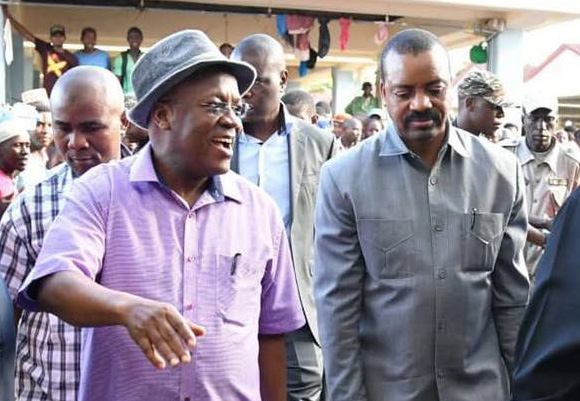
His hands-on style rippled to Kasumulu town along Songwe River, the boundary between Tanzania and Malawi. The stuffy town instantly transformed into a spotless business hotspot, with traders proudly invoking Magufuli’s decree to persuade buyers to refuse plastics, dump leftovers in bins and keep Tanzania clean.
Meanwhile, refuse kept piling and spilling on the Malawian side, where indiscriminate waste disposal continues unchecked. Along the M1 from Songwe in Karonga District at the northern tip to the southernmost market of Chididi in Nsanje, growing waste molehills flash past, alerting travellers: You are approaching a fast-urbanising community too busy to mind its sanitation and well-being.
Centre for Environmental Policy and Advocacy executive director Herbert Mwalukomo wants Mutharika to magufulify Malawi amid festering plastic pollution.
He states: “The talk of Mutharika’s commitment to a clean environment is noteworthy. If this is anything to go by, it sets a high tone for his government’s environmental management agenda.
“Magufuli showed us that policy reforms are possible with political will. This is the right time for the Mutharika administration to demonstrate commitment. Hopefully, it will translate into action.”
Second chance
Mutharika springs back to power six years after being voted out in the June 2020 presidential election courts sanctioned due to rampant irregularities in the 2019 presidential election he was declared winner.
He won last month’s poll with about 57 percent of the vote, according to Malawi Electoral Commission (MEC).
“There is no time to waste,” says Mwalukomo. “The nation needs a reset and Malawians don’t expect to see what they used to do five years ago.”
In 2019, four months after his disputed re-election, Mutharika went shopping with a single-use plastic carrier bag outlawed by his government four years earlier, but suppressed by a court order.
The photograph poured cold water on the ban announced on June 30 the same year.
Three months earlier, Magufuli stormed a fish market carrying a wicker basket in support of his country’s ban on single-use plastics polluting land, water bodies and air.
Expectedly, Mutharika’s shopping spree stirred a backlash from environmentalist.
“The incident was an offside. It means that people in high places simply do not care and that is what I quickly picked,” anti-plastic advocate Tiwonge Gawa told The Nation.
Yet, two years into his reign, Malawi joined pioneer African States to ban the production, importation, distribution of single-use plastics thinner than 60 microns.
However, implementation stuttered with a barrage of court orders obtained by plastic manufacturers opposed to the environmental management regulation.
Mutharika springs back nine months after the High Court dismissed a judicial review case launched by the profit-making firms.
In his verdict, Judge Howard Pemba rebuked the petitioners for abusing the courts by flooding them with related cases.
“If the court was made aware of the numerous previous court proceedings relating to this same subject matter [the ban on thin plastics], permission to apply for judicial review would not have been granted,” he ruled in January.
Mwalukomo wants Mutharika to make amends and declare Malawi a no-go zone for thin plastics and businesses that make profit at the expense of the environment and human health.
“The abuse of courts and continued manufacturing, importation and sales of thin plastics in Malawi are a sign that all governments have not done enough to make thin plastics history.
“So, this is an opportunity for Mutharika to pick up where he stopped five years ago. If he says enough, all Malawians, businesses and State institutions will know time is up for the banned plastics.”
Beautify Malawi
His predecessor Lazarus Chakwera said no word to add weight to the ban, but launched a monthly national clean-up day—like Rwanda’s Umuganda—which faded within months.
However, Mutharika does not lack pep talk on the importance of a clean environment as his wife’s charity, Beautify Malawi Trust, popularised market clean-up campaigns during his debut term between 2014 and 2019. The First Lady offers a good example of how non-state actors and influencers can support the national push for a right to a clean, healthy and sustainable environment.
However, enforcement by authorities remains sluggish and scanty, lacking political will from the helm.