The first full budget of the Democratic Progressive Party (DPP) administration since its September 16 election victory has drawn praise from non-partisan thinkers for its development focus, but attracted criticism from opposition parties.
Presenting the 2026/27 National Budget in Parliament yesterday, Minister of Finance, Economic Development and Decentralisation Joseph Mwanamveka outlined spending priorities centred on economic stabilisation, agriculture, tourism, mining and manufacturing.
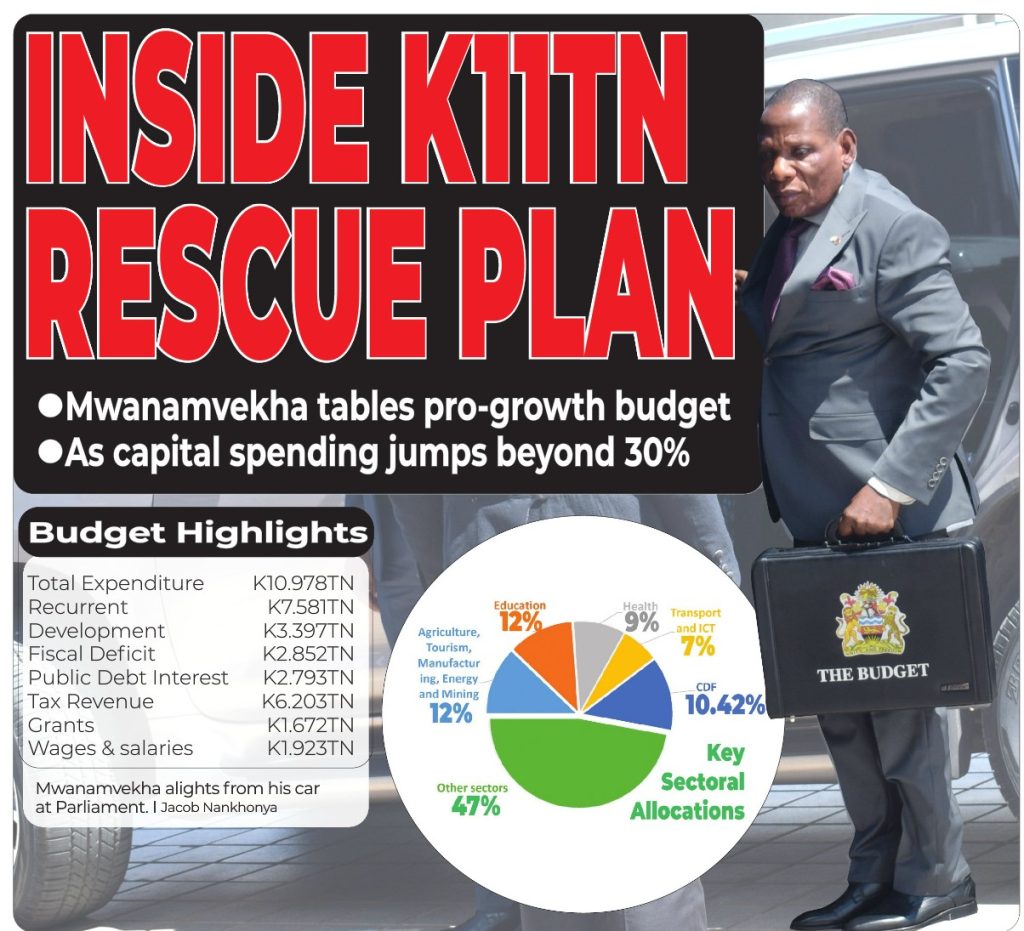
Malawi Economic Justice Network (Mejn) executive director Bertha Phiri described the budget as “well blended” and “developmental,” citing the allocation of 30.9 percent of the national cake to development—one of the highest in history.
“We commend government because the Consolidated Development Fund will be decentralised to councils for operationalisation of communities. Citizens will be part and parcel of development planning,” said Phiri.
She also welcomed tax measures removing import duties on equipment for technical colleges and praised the introduction of a national exchange market to stabilise prices and e-procurement measures to curb illicit financial flows.
Bankers Association of Malawi president Phillip Madinga commended the reduction of capital gains tax on shares from 30 percent to 13 percent, saying it demonstrates government listens to private sector concerns.
“You have a minister who went out consulting the public and the private sector. One outcry was capital gains tax on shares. He announced today they have scrapped the 30 percent and introduced 13 percent. This is good news for everybody who has shares on the market,” Madinga said.
Economics Association of Malawi (Ecama) president Bertha Bangara-Chikadza welcomed the increase in value added tax (VAT) thresholds from K25 million, describing the previous threshold as “cumbersome” and burdensome. She also praised expenditure control measures and efforts to close revenue leakages through digitisation and Malawi Revenue Authority (MRA) reforms.
On his part, Malawi Local Government Association (Malga) executive director Hadrod Mkandawire congratulated Mwanamveka for presenting a “progressive, ambitious and bold” budget, expressing excitement over allocations to councils.
He noted that K1.145 trillion has been allocated to local authorities under the reformed Constituency Development Fund, representing 33.7 percent of the national development budget.
“This is unprecedented and gives a good picture in terms of government matching policy aspirations with action,” said Mkandawire.
“We just hope disbursements will also be good because the trend has been that the actual disbursement against approved estimates has been a big mismatch.”
However, Mkandawire pointed to gaps in recurrent funding, citing the health sector as an example.
“Only K50 billion has been allocated to district council health operations, representing just 4.9 percent of the total K1.02 trillion allocation to the health sector. This is a big mismatch in terms of functions and resources, yet most health services are anchored at the local level,” he said.
He also expressed disappointment that government overlooked Malga’s request for import duty exemptions for ward councillors to purchase one vehicle every five years.
“Most of them cannot afford to buy these vehicles with duty. This is an area we expected the minister to consider, but it has been overlooked once again,” Mkandawire said.
But Leader of Opposition Simplex Chithyola-Banda said the budget fails to address pressing concerns facing ordinary Malawians, particularly on taxation.
Chithyola said government ignored public outcry over tax measures that have reduced take-home pay for civil servants.
“There has been a general outcry on some taxes like the Pay As You Earn, which has actually affected the take-home of many civil servants. We thought government would revise it, but there is just silence. Instead, they are introducing more taxation, taxing the very same person,” said Chithyola-Banda.
He likened the approach to demanding more from those already struggling.
“It is like you want a poorly fed cow to give you more milk. Instead of getting more milk, it is blood that comes out of it.”
On maize price controls, which the minister presented as an achievement, Chithyola-Banda warned of unintended consequences.
“We need to look at this from both the demand and supply side. If we don’t address the cost of production, we will demotivate the farmer and that will affect future production, resulting in future hunger,” he said.
Chithyola-Banda also criticised the free secondary education announcement as “partial”, noting that government is silent on boarding fees.
“The larger portion of costs is actually boarding fees. Government is deliberately running away from it because they know it is exorbitant,” said Chithyola-Banda.
He further questioned the allocation of K7 billion for special economic zones, with K6 billion going to Chigumula and only K1 billion shared between Magwelo and Dwangwa.
“What was the modus operandi for that kind of distribution? It leaves so many questions. Magwelo is bigger. Why not distribute two billion to each? This means there is a political connotation attached,” said Chithyola-Banda.