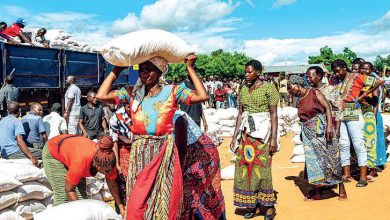
Malawi’s social protection initiative faces a funding cut from K217 billion in the 2025/26 financial year to K123 billion in the 2026/27 financial year, putting livelihoods of at least one million ultra-poor and labour-constrained households at risk.
United Nations Children’s Fund (Unicef) Malawi chief of policy Mathews Tasker has attributed the projected K94 billion slash to declining donor contributions.

number of beneficiaries. | Nation
The cut is expected to affect several flagship safety net initiatives, including the Social Cash Transfer Programme which could see funding fall by 14 percent, the Climate-Smart Enhanced Public Works Programme by 57 percent and the Urban Public Works Programme by 35 percent.
Collectively, the programmes, funded by the World Bank and other partners such as the European Union (EU), Germany/KfW, and Ireland with Unicef providing the technical assistance and support, benefit at least 270 000 households or 1.1 million individuals, including 641 000 children.
Presenting an analysis of macroeconomic trends and financing options for social protection yesterday in Lilongwe during an engagement between child rights stakeholders and the Parliamentary Cluster Committee on Social and Community Affairs and Local Authorities as part of scrutiny for the proposed K10.9 trillion 2026/27 National Budget, Tasker warned that the cuts could significantly weaken key programmes supporting the poorest households.
He said the situation highlights the urgent need for Malawi to strengthen domestic financing for social protection.
“There is need to move towards full national ownership by building on government’s expanded Social Cash Transfer Programme investment to progressively cover more beneficiaries,” said Tasker.
On a positive note, he commended the Malawi Government for increasing its contribution to the programme from K4.4 billion to K7 billion.
In a related development, a child-friendly budget analysis by civil society organisations promoting children’s rights has also raised concern about a 30 percent slash in the budget allocation to the Ministry of Gender, Children, Disability and Social Welfare from K69.7 billion in 2025/26 to K48.9 billion in 2026/27.
NGO Coalition on Child Rights programmes officer Faith Iwalani said the reduction could affect the ministry’s ability to coordinate programmes addressing challenges in the social sector.
She noted that funding for early childhood development (ECD) programmes has also dropped drastically from K25 billion to K1.7 billion, representing a 93 percent decrease following the phasing out of the World Bank-funded Early Years for Growth and Productivity project in 2025. Meanwhile, Malawi Government allocation to ECD has also dropped from K1.3 billion to K300 million in the proposed budget.
Iwalani called for increased domestic financing for ECD programmes and proposed that part of the K5 billion Constituency Development Fund (CDF) allocation be directed towards ECD infrastructure and services.
NGO Coalition on Child Rights national coordinator Henry Machemba said Malawi needs to increase investment in child protection, noting that current allocations translate to about K200 per child annually.
“There are a number of challenges in child protection, including child marriages and abductions. Systems that government put in place to protect children are not working effectively,” he said.
In her contribution, EU clear section team leader Denisa Salkova commended the Malawi Government for increasing funding to the social cash transfer and allocating K2 billion to the Disability Trust Fund, but said more resources are needed for ECD programmes.
Parliamentary cluster co-chairperson Savel Kafwafwa has described the projected funding drop as alarming, saying: “This programme is collapsing. Almost half of the funding has gone. Government needs to find alternative sources of financing to sustain these programmes.”
He said the committee is lobbying that 10 percent of the K5 billion CDF should be directed to ECD programmes to address infrastructure and service gaps.
National Children’s Commission vice-chairperson Benedicto Kondowe also expressed concern about the decline, warning that heavy reliance on donors makes social protection programmes vulnerable to shifting priorities.
“It is a serious concern because social protection targets vulnerable groups, children, women and persons with disabilities. When donors change priorities, the programmes suffer,” he said.
Kondowe said Malawi must invest more deliberately in children if it is to achieve its long-term development goals.
Minister of Gender, Children, Disability and Social Welfare Mary Navicha and Principal Secretary Esmie Kainja could not be reached for comment by press time at 9pm yesterday.
Social cash transfer, also known as Mtukula Pakhomo, helps ultra-poor, labour-constrained households, particularly helping through improved school attendance and nutrition.
Funding for social protection had been rising in recent years from K52 billion in the 2021/22 financial year, to K65 billion in 2022/23, K132 billion in 2023/24 and K224 billion in 2024/25, before declining to K217 billion in the current 2025/26 financial year.