Malawi Enterprise Development Fund (Medf) says it has started disbursing new loans targeting 260 000 beneficiaries nationwide in the current financial year.
BriefingthemediainLilongwe yesterday, Medf chief executive officer Kayisi Sadala said the loans seek to economically empower Malawians and promote sustainable enterprise development across different sectors of the economy with a particular focus on underserved communities.
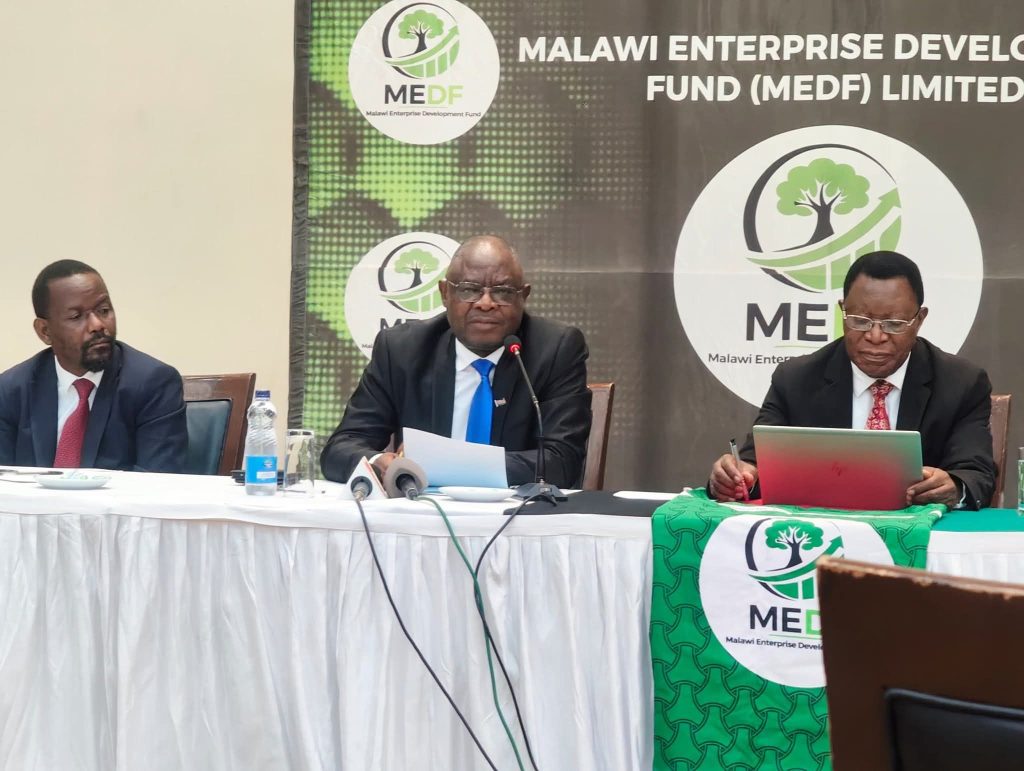
He said the institution, which rebranded from National Economic Empowerment Fund (Neef), has streamlined its loan portfolio from 26 products to nine comprehensive ones designed to incorporate and accommodate the previous offerings.
Sadala said K100 billion is earmarked for disbursement during the current financial year, including funds for beneficiaries of the reformed K5 billion Constituency Development Fund (CDF).
He added that the loan recovery rate remains low with a default rate of 52 percent, adding that the institution has introduced several initiatives aimed at improving loan recovery.
On the streamlined loan portfolio, Sadala said the products are Government of Malawi Employees Loans, Youth Empowerment Loans, Women Empowerment Loans, Men Empowerment Loans, Agricultural Production Loans, Cooperative and Industrialisation Loans, General Trading Loans, Asset Financing Loans and Micro-Insurance Loans.
He said: “The fund is now placing greater emphasis on group lending as a way of strengthening collateral support and minimising loan default risks, as group members provide security for one another. However, individual loan applications are still welcome, provided adequate collateral is available.”
Sadala added that Medf will gradually begin disbursing CDF loans with each constituency receiving K200 million.
He said the funds will be equally distributed between youth aged 18 to 35 and women aged 35 to 75 with access to the loans tied to groups comprising five to 10 members receiving between K2.5 million and K5 million.
Breaking it down further, Sadala said each individual beneficiary will be eligible for a minimum of K250 000 and a maximum of K500 000.
Commenting on the arrangement in an interview yesterday, Mzuzu University-based economist Christopher Mbukwa said Medf will remain ineffective in boosting small-scale businesses unless its operational approach is changed and the institution is detached from government influence.
Centre for Social Accountability and Transparency executive director Willy Kambwandira said the 52 percent default rate is a warning that loan disbursement alone is not enough and that the institution still has significant groundwork to do to ensure the loans being issued do not go to waste.
Smal l- scale Business Operators Association of Malawi general secretary Tennyson Mulimbula said business operators expect the resumption of loan disbursement to depart from previous trends where regionalism and political affiliation allegedly influenced access to loans.
Similarly, gender rights activist Emma Kaliya said loans disbursed through the institution often fail to benefit the intended recipients.
Medf has an entire loan portfolio of K240 billion, benefiting 377 460 Malawians as of December 2025, with K116 billion disbursed in 2025 alone.
After the 60-day ultimatum issued for loan repayments, only K8 billion was repaid leaving out an unpaid sum of K187 billion. From April to date, the institution has collected K6 billion from the individuals that owed them.
Established on January 29 2005, through a presidential decree, the institution has evolved over the years from Malawi Rural Development Fund (Mardef) to Medf in 2014 and later Neef in 2020 before reverting to Medf earlier this year.