Just beyond the green expanse of tea estates that define much of Thyolo District, Khonjeni Extension Planning Area (EPA) sits quietly in Traditional Authority (T/A) Kapichi, a place that for years bore little resemblance to a functioning agricultural service centre.
Unlike typical EPAs nationwide, Khonjeni once had no permanent office block and no staff house for extension workers. For thousands of farming households spread across the area, agricultural advisory services depended on makeshift arrangements that often failed when they were needed most.
Farmers met in a small rented structure that was too limited to accommodate growing numbers. Extension workers, based far from Khonjeni due to lack of accommodation, struggled to reach the area consistently. During the rainy season, poor access roads often cut off services entirely, leaving farmers without timely guidance at critical moments in the farming calendar.
Lead farmer Mwandida Mukhuli recalls how these gaps shaped daily agricultural life across the area.
She says: “We struggled because the office we were using was very small and not properly structured. When we needed to meet or when materials for farmer clubs had to reach us, everything became difficult.
“Our extension workers were coming from far away because there was no house for them here. During the rainy season, it became hard for them to reach us and we often missed important agricultural advice when we needed it most.”
That reality has now shifted following the construction of a new EPA office block valued at K190 million and a staff house for extension workers valued at K234 million, implemented under the Regional Climate Resilience Programme.
Together, the facilities have restored the functionality of Khonjeni EPA, which serves 28 726 farming households across seven sections, re-establishing it as a fully operational agricultural support centre.
Standing at the centre of the new infrastructure, Mukhuli says the change is already visible in how farmers organise themselves and respond to agricultural challenges.
“We now have a proper place for our meetings and the extension worker lives close to us. We regularly meet to discuss farming practices that help us respond to climate change,” she says.
Area Agriculture Stakeholder Panel chairperson Paul Muloza Banda says the investment has strengthened coordination across the vast T/A Kapichi where rainfall patterns vary from one locality to another, complicating planting decisions for farmers.
“A major challenge was to understand how the weather was changing because extension workers stayed far away,” he explains.
Agriculture Extension Development coordinator Clara Benart Mandula says the transformation has fundamentally improved how extension services are delivered.
She explains that before the new infrastructure, meetings were often held under a tree, leaving them vulnerable to disruption whenever weather conditions changed.
With a permanent office now in place, farmers can access support throughout the year.
Mandula notes that climate change is already reshaping farming conditions in the area through erratic rainfall, prolonged dry spells and increasing outbreaks of pests and crop diseases affecting maize and cassava.
In response, extension officers are promoting drought and disease-resistant crop varieties, encouraging early removal of infected plants and supporting the use of botanical pest control methods such as tephrosia.
Farmers are also being trained in soil and water conservation techniques, including box ridges and pit planting, to help improve resilience under increasingly unpredictable weather conditions.
She further says that the presence of a functional EPA has improved technical support to initiatives such as the Madalitso Irrigation Scheme, where farmers now receive guidance on plot layout and crop management that was previously unavailable.
Across Malawi, experts warn that such interventions are becoming increasingly urgent as climate variability intensifies pressure on rain-fed agriculture and rural livelihoods.
Nearly 140 kilometres from Khonjeni, another investment under the Regional Climate Resilience Programme is changing lives in a different way.
At Magomero in Chiradzulu District, a rehabilitated earth road branches off John Chilembwe Highway and winds towards Namadzi River, linking rural communities with Mbulumbuzi Market, Nansawa Technical College and other essential services.
For years, the road had become increasingly difficult to use. Heavy rains carved deep gullies into its surface, sections became slippery and impassable and vehicles frequently became stuck in mud.
During the rainy season, some transporters simply abandoned the route altogether, forcing communities to rely on lengthy detours. Senior Chief Nchima says the road is one of the area’s most important public assets because it serves people from surrounding communities, including group village heads Balakasi and Nyimbiri, while providing access to the technical college and the district’s main trading centre.
For farmers, improved mobility has translated into improved access to markets.
Area Development Committee chairperson Alfred Piyo recalls that poor road conditions once made it difficult for growers to transport maize, tomatoes, pigeon peas, potatoes, cabbage and beans to buyers.
“There were times when drivers had to turn back and use other routes just to reach us,” he explains.
According to Chiradzulu District Council Engineer Bridget Kachokam’manja, the K268 million project involved reshaping 8.1 kilometres of road, spot gravelling 1.2km, cleaning existing culverts, constructing a single-cell box culvert, masonry drains, check dams on steep sections and gabion baskets at Namadzi Bridge to protect the crossing from flood damage.
She says the interventions have restored reliable access along the corridor while strengthening the road against future climate-related damage.
Further east, in Balaka District, climate resilience has taken a different form.
As daylight fades, solar-powered streetlights illuminate a section of the township loop road that was once associated with fear and insecurity. Today, traders remain open late in the night, pedestrians walk with greater confidence and motorcycle taxi operators continue working long after sunset.
Kabaza operator Leston Msamala remembers when darkness gave criminals an advantage.
“Before these streetlights were installed, thieves hid along the roadside and attacked people,” he says.
His fellow operator, Chisomo Nyalugwe, says the change has brought both security and better earnings.
“The road used to be very dark and almost every week someone was attacked or lost a bicycle,” she says.
Balaka District Council Engineer Raymond Innocent Zulu says the K62 million project installed 18 solar-powered streetlights along one kilometre loop road in the township loop road. Community sensitisation campaigns were conducted before installation to encourage local ownership and safeguard the infrastructure against vandalism.
Balaka district commissioner Bibu Yusufu Mdala says the project has produced benefits that extend beyond improved security.
He notes that businesses are operating for longer hours, residents can move around more safely at night and the improved public lighting has given the township a renewed sense of vibrancy.
From restored rural roads in Chiradzulu to safer streets in Balaka, the investments reflect a broader approach to climate resilience, one that recognises that communities cannot adapt to a changing climate without reliable infrastructure that supports livelihoods, public services and local economic activity.
In Mchinji District, climate resilience is taking shape inside the classroom.
At Kadagwantipenya Primary School in T/A Zulu, pupils once learnt under trees and in temporary shelters that offered little protection from rain or strong winds.
School Management Committee chairperson Undani Osward says the school had long struggled with poor infrastructure.
“There were no proper classrooms and learners were using temporary structures because we had no alternative,” he says.
The school’s deputy head teacher Maxwell Ganangwe says the new classroom block has transformed both learning conditions and enrolment.
“We used to teach under trees and learners suffered whenever it rained,” he explains.
For Standard Seven learner Margret Damiano, the change is expressed in simple but meaningful terms.
Mchinji District Council director of planning and development Smith Mnenula says the district received K1.016 billion under the first cycle of the Regional Climate Resilience Programme to implement five education infrastructure projects. About 360 learners have already benefited from completed classroom blocks, while two additional projects remain under construction.
Department of Climate Change and Meteorological Services director Lucy Mtilatila says El Niño conditions have started developing in the tropical eastern Pacific Ocean, increasing the likelihood of below normal rainfall over Malawi during the next rainy season.
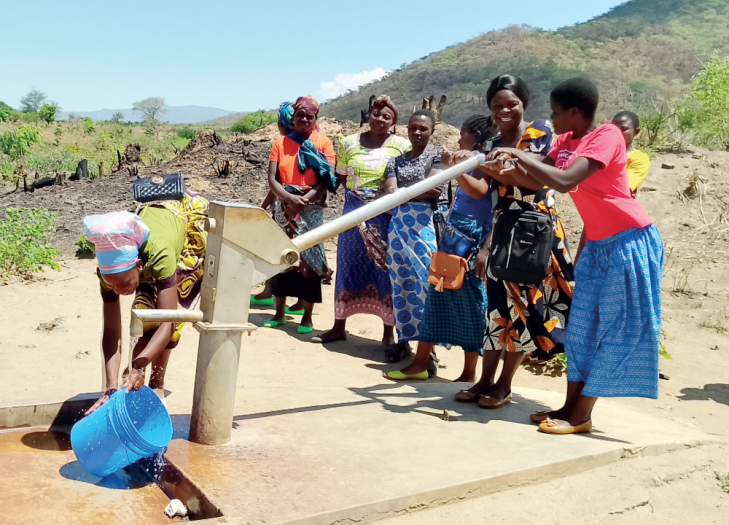
That call for preparedness is already finding practical expression in communities such as Gideon Village in T/A Chilowamatambe in Kasungu District, where access to clean water has become an important part of strengthening resilience.
As Malawi prepares for another rainy season amid the possibility of below normal rainfall, these investments are helping communities to withstand climate shocks.