International Telecommunication Union (ITU) Secretary General Doreen Bogdan-Martin has called for urgent global action to make artificial intelligence (AI) benefit all people as technology has the potential to transform lives if used responsibly.
She said during the opening of the AI for Good Global Summit 2026 in Geneva, Switzerland yesterday that AI is already driving breakthroughs in healthcare, education, agriculture, climate monitoring and public service delivery, thereby creating opportunities to accelerate progress towards the Sustainable Development Goals (SDGs).
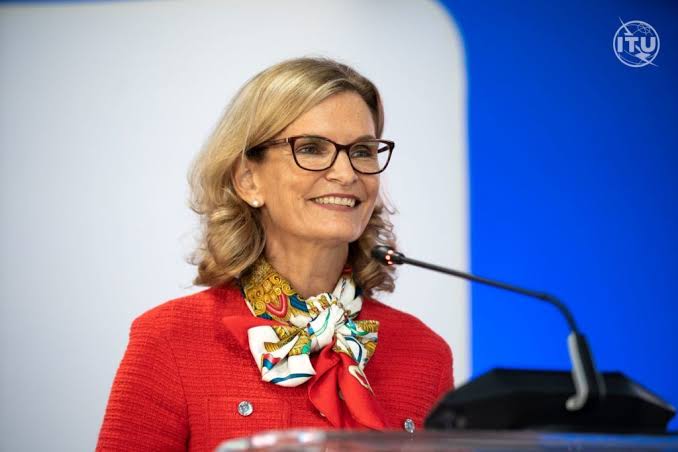
Bogdan-Martin said AI could help developing countries to compress decades of development into a few years while enabling advanced economies to boost productivity, innovation and economic growth.
“AI is helping researchers accelerate scientific discovery, improve disease diagnosis, enhance disaster prediction and strengthen food security,” she said.
Bogdan-Martin noted that the technology is creating new possibilities for governments, businesses and communities to solve complex challenges more efficiently than ever before.
But she warned that the benefits of AI will not be shared equally unless deliberate efforts are made to close the global digital divide., noting that 2.2 billion people remain offline and at risk of exclusion from the opportunities presented by the AI revolution.
Bogdan-Martin further emphasised that international cooperation and technology development must move forward together if AI is to benefit everyone.
Highlighting milestones already achieved in the AI sector, she said more than one billion people worldwide now use conversational AI tools every week and that AI adoption has expanded at a pace unmatched by previous digital technologies. She said the rapid growth demonstrates both the transformative power of AI and the urgency of establishing effective governance frameworks.
Bogdan-Martin’s remarks echoed concerns raised earlier by United Nations Secretary General António Guterres who warned that AI is advancing faster than governments and regulators can keep pace.
He said a technology capable of reshaping economies, influencing elections, transforming labour markets and affecting global security requires strong safeguards and globally harmonised rules.
Guterres also expressed concern over the growing concentration of advanced AI capabilities in a small number of countries and companies, warning that developing nations risk being left behind.
The UN chief also decried misinformation, cyber threats, manipulation of children through AI systems, loss of human oversight and the possibility that powerful AI tools could be misused for harmful purposes if adequate protections are not established.
Despite the highlighted risks, both leaders maintained that AI can become a powerful force for good if governed responsibly and made accessible to all.
Recently, the World Bank selected Malawi to pilot an AI initiative aimed at enabling people to access information and digital services in local languages.
With funding from Gates Foundation, the project will train AI models to understand and communicate in Chichewa, potentially opening up access to information for millions of Malawians who primarily use local languages.
Minister of Defence Feston Kaupa, who represented the Malawi Government at the launch of the initiative in Lilongwe, welcomed the initiative, describing it as a significant step towards ensuring that Malawi is not left behind in the rapidly evolving digital economy.