Prices of coffee have fallen by 23.8 percent at the start of this year’s selling season, with data showing that primary processed coffee is now trading at K16 000 per kilogramme (kg), down from about K21 000 per kg last year.
Coffee Association of Malawi (Camal)’s has attributed the decline in price to increased production in Brazil and Vietnam, two of the world’s main coffee producers and local coffee cooperatives have expressed concern with the extent of the drop.
In an interview on Friday, Camal secretary general Kondwani Nanchukwa said the prices are ranging from K14 000 to K16 000 per kg, but insisted the prices are still better than neighbouring countries.
He said: “It is a discouraging season for the farmers in Malawi as opposed to last year, but a relief to off-takers and processors.
“But despite the reduced price range, Malawi coffee is highly priced compared to other countries at the moment.”
Camal’s price analysis shows that Tanzanian processed unit parchment Arabica coffee is ranging from 11 986 Tanzanian shillings per kg to 12 323 Tanzania shillings per kg, which translates to about K8 010 per kg.
“Malawian farmers should, therefore, still consider themselves lucky since they are selling the crop at higher prices compared to the others,” said Nanchukwa.
Rumphi-based Phoka Coffee Growers Cooperative development manager Rodney Mbowe, in an interview on Friday, decried the declining prices, but added that his cooperative is determined to attain its 200 metric tonnes (MT) production target this year.
He said that the cooperative was expecting prices to hit K25 000 per kg after reaching K21 000 per kg last year, but added that buyers are offering as low as K15 000 per kg, which is below the global market.
“Looking at the flow and comparing the prices at the world market, the prices are low this season with some buyers in Chitipa District offering as low as K15 000 per kg.
“Post-harvest preparations started early in June and we are at the peak. We have managed well to aggregate the coffee in all our washing stations,” said Mbowe.
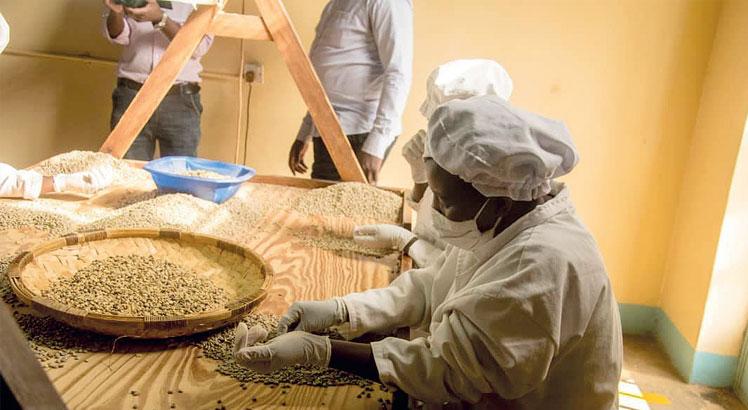
factory in Blantyre. | Nation
Meanwhile, Usingini Upland Coffee out-growers national coordinator Dominic Joseph, whose firm is a coffee off-taker, said the dropping prices in the region benefits local processors as it reduces smuggling.
He said: “There isn’t much smuggling this year because Tanzanian buyers and others are not flocking into the country as much as last year.
“Reports indicate that there is a lot of coffee in Tanzania this year, which is selling at lower prices compared to Malawi and most of those vendors are not flocking into the country.”
Last year, the price of parchment coffee surged by 200 percent from about K7 000 per kg in 2024 to about K21 000 per kg as traders from neighbouring countries increased competition by participating on the domestic market.
Coffee production remains low as Malawi is now producing 1 000MT per annum from as high as 7 000MT in recent years.
Data from the 2026 Malawi Government Annual Economic Report show that coffee export values have fluctuated in recent years, rising to $2.8 million (about K4.9 billion) in 2021, falling to $1.1 million (about K1.9 billion) in 2022 and then rising to $1.6 million (about K2.8 billion) in 2023 and $3.4 million (about K6 billion) in 2024.
During the launch of the 15-year Malawi Coffee Strategy last November, Minister of Agriculture, Irrigation and Water Development Roza Mbilizi said the blueprint could transform the sector into a strong value chain capable of earning $240 million (about K420 billion) annually by 2040.