First Vice-President Jane Ansah appears to be crawling out of her cocoon amid a purported fallout with President Peter Mutharika.
On July 31, the former Malawi Supreme Court of Appeal judge and Malawi Electoral Commission (MEC) chairperson ended the chilly month in a no-nonsense mood—distancing herself from any sentiments likely to fuel tension in the Presidency.
This was the first time for Ansah, a retired Justice of Appeal, to publicly speak out on her relationship with Mutharika since he opted for Second Vice-President Enoch Chihana to chair a Cabinet meeting where she was absent. She was not invited, said her spokesperson Richard Mveriwa.
The statement caps a perceived rift with the President, who handpicked her as his running mate in the September 16 2025 General Election.
Writing on her official Facebook page last week, Ansah said she commits to unity of the presidency, constitutional governance and responsibility.

“Together, let us continue to uphold the values that unite us as a nation,” she wrote, farming out a statement from her communications office disassociating her from statements and actions that “undermine unity of the presidency”.
According to Mveriwa, the First Vice-President’s office does not support or endorse any position that is inconsistent with constitutional order or likelihood to erode the stability of the presidency.
“She [Ansah] remains fully committed to the constitutional mandate entrusted to her office and to working in support of the President of the Republic of Malawi,” he said.
The statement came barely days after Ansah was sidelined from a Cabinet meeting chaired by Chihana last Monday.
The same week, activist Sylvester Namiwa claimed in an interview with Luntha Television that Ansah might become Malawi’s President within two months unless a governing Democratic Progressive Party (DPP) Big Five tones down on their misconception that they own the party led by Mutharika .
Ansah’s statement, however, did not specifically refer to any scenario.
Political analysts say the statement shows respect for the Constitution, but bares her cautious steps in the midst of the purported fallout with Mutharika.
Political analyst Chimwemwe Tsitsi, from Malawi University of Business and Applied Sciences, describes Ansah’s statement as commendable considering speculations about sour relations between her and Mutharika.
The analyst says sustained silence amid such speculations may just bring about unnecessary tension among her sympathisers and the President’s followers.
Keeping mum may also bring uncertainty among the citizenry, he warns.
Tsitsi adds that sometimes it is public perception, rather than reality, that shapes national discourse and behaviour.
He states: “A good leader should be quick to address any misconceptions of the reality and put to rest any misguided speculation.
“However, reading between the lines as you go through the statement, you will see that the words and phrases used were carefully chosen, with some communication mastery that simply states or reiterates the values that the First Vice-President subscribes to when it comes to governance.
“Neither does it touch on the specifics of the said allegations nor emphatically say, in any way, that what has been happening to the First Vice-President in relation to anything is constitutionally acceptable and fully supported by the VP.”
Tsitsi says much as the statement clearly distances the First Vice-President from any “statements, opinions and actions” to do with the alleged disunity at the helm, it still leaves it to members of the public to judge on their own on what has been happening.
Tsitsi says: “Going by this, it is clear that for someone who subscribes to constitutionalism, respect for the presidency and unity of purpose as the First Vice-President, she is likely not to complain if, for example, what the President does may violate the psychological contract—what is normally expected, much as it may not be written down—that exists between the President and the VP, but does not necessarily violate the Constitution.
Last June, Mutharika appointed Minister of Education, Science and Technology Bright Msaka to represent him at the unveiling of Vice-President Saulos Chilima’s mausoleum in Ntcheu where Ansah was also in attendance.
The Nation asked State House press secretary Cathy Maulidi about the latest statement from Ansah’s spin doctor.
“No comment,” she replied.
However, political analyst Ernest Thindwa says Ansah has acted with utmost maturity and professionalism in the face of perceived marginalisation.
“It appears the public’s less admirable image of the relationship between the President and [First] VP, real or imaginary, is a patterned feature of Malawian politics to be addressed in nurturing constitutionalism.”
Mutharika surprised his inner circle when he picked Ansah as his running mate in last year’s general election.
The pair won the poll with 56.7 percent of the vote, ousting incumbent Lazarus Chakwera of Malawi Congress Party.
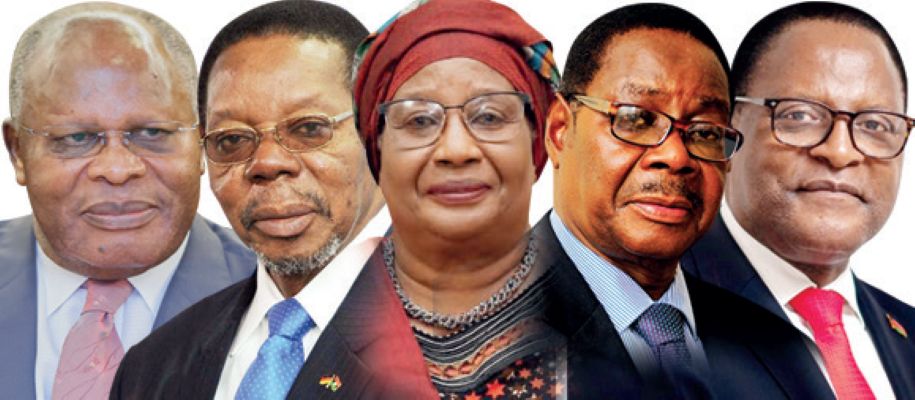
The late Justin Malewezi, Malawi’s first VP after the fall of founding president Hastings Kamuzu Banda’s 31-year one-party rule in 1994, described the vice-presidency as poisoned chalice having fallen out with his boss, former president Bakili Muluzi, in 2003.
Malawi’s presidency has historically been characterised by strained relationships.
Muluzi publicly criticised and ditched Malewezi ahead of the 2004 elections, when the revered VP ran as an independent presidential candidate.
There were more of the same in 2005 when the late Bingu wa Mutharika dumped Cassim Chilumpha, who still grapples with treason charges dating to the tense period when the pair fell apart.
The two fell out shortly after Bingu ditched the United Democratic Front (UDF) to form DPP.
During Bingu’s second term, his then vice-president Joyce Banda was dismissed from the DPP as the party groomed his younger brother, Peter, for the presidency.
When Bingu died in April 2012, Banda, who had been banished from the governing party, became the country’s first woman president as required by the Constitution.
Peter Mutharika defeated Banda in 2014 when he paired with Chilima. However, the two separated and traded barbs in the countdown to the 2019 General Election when Chilima quit DPP to form UTM Party as some DPP loyalists rejected him as a rank outsider.
Chilima later paired with Chakwera in the June 2020 Court Ordered Presidential Election in which they defeated Mutharika with a landslide vote. However, the Tonse Alliance duo fell out again, with Chilima charged with corruption in relation to an arms’ deal that collapsed on request from the State.
Chakwera also stripped off Chilima’s delegated roles.