The African Development Bank (AfDB) says Malawi requires an estimated $3.3 billion (about K5.8 trillion) in additional financing annually to close its development financing gap by 2030.
The K5.8 trillion financing gap accounts for over half or about 58 percent of the 2026/27 National Budget pegged at about K10.9 trillion.
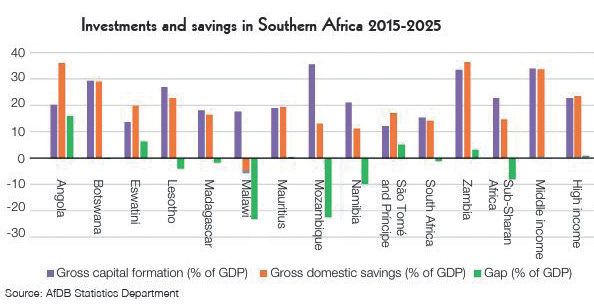
AfDB’s Southern Africa Economic Outlook 2026 shows that the gap is equivalent to 29.4 percent of Malawi’s 2024 gross domestic product (GDP), making it one of the highest financing pressures relative to economic size in the region.
While the Malawi economy is smaller than most regional peers, its financing gap ratio is lower than Namibia at 84.1 percent, Madagascar at 40.6 percent, Mozambique at 38.8 percent and Lesotho at 37 percent.
The report indicates that Malawi’s challenge reflects wider regional constraints, including low domestic savings, limited fiscal space, underdeveloped capital markets and declining access to affordable concessional financing.
Reads the outlook in part: “Southern Africa’s most binding development financing challenge is not simply a shortage of resources, but the limited capacity to mobilise, intermediate and deploy available capital efficiently at scale.”
The AfDB notes that addressing these financing gaps will also require attracting more private investment through blended finance mechanisms and improving investment frameworks across the region.
The report comes at a time Malawi’s fragile public finances are under renewed strain due to global aid cuts that expose deep structural flaws in its economic model.
According to the International Monetary Fund (IMF), bilateral aid to the region, including Malawi, fell by an estimated 16 to 28 percent in 2025.
The timing is particularly difficult for Malawi as its public debt has reached K23.9 trillion or 90 pe rcent of the GDP as of as of December 2025.
Scotland-based Malawian economist Velli Nyirongo, in an interview, said that given Malawi’s current economic structure and challenges, it would be difficult for the country to fully bridge the financing gap through domestic means alone.
“A multi-faceted approach combining domestic resource mobilisation, improved tax administration, foreign aid, concessional loans and private sector engagement is necessary to address the financing needs effectively,” he said.
But Nyirongo said this will require strong political will, sound economic policies and effective governance to ensure that resources are used efficiently and effectively for the intended structural transformation.
In an earlier statement, IMF cautioned that financing debt and imports will remain a challenge for Malawi despite improvements in filling the gap unless the country’s unsustainable debt is addressed.
The United Nations (UN) in May said funding constraints remain a major limitation to the country’s commitment to the 2030 Agenda for Sustainable Development and its long-term development strategy, Malawi 2063 (MW2063).
The UN’s Malawi’s 2026 Voluntary National Review update indicates that despite progress on 17 Sustainable Development Goals, high public debt and heavy reliance on external financing are limiting the Malawi Government’s ability to scale development programmes and respond effectively to shocks.
On the other hand, a joint analysis by the National Planning Commission and Economics Association of Malawi show that over the past five years, only 44 percent of the total funds needed to finance the MW2063 First 10-Year Implementaiton Plan (MIP-1)interventions have been allocated, leaving a financial gap of K7 trillion.
For instance in 2022, the review indicated that the total estimated cost of MIP-1 implementation was about K2.5 trillion while only about K640 billion was allocated in the national budget for MIP-1-related interventions, representing an underfunding gap of about 80 percent during that period.