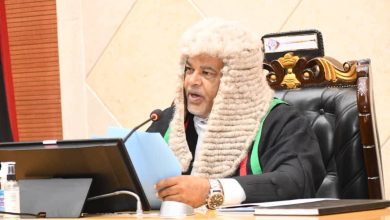
When Minister of Finance, Economic Planning and Decentralisation Joseph Mwanamvekha presented the 2026/27 National Budget Statement before Parliament last week, he promised that this budget would stabilise the economy and prioritise people’s welfare.
On paper, the numbers support that claim. Health receives K1.02 trillion. Agriculture is allocated K931.1 billion. Education programmes include K47.6 billion for free primary and secondary schooling and K42 billion for student loans. The expanded Constituency Development Fund (CDF) alone accounts for K1.145 trillion.
These allocations signal that the government recognises that investing in people remains central to long-term development.
Yet budgets are judged less by their intentions than by their outcomes.
Behind the social spending commitments lies a difficult economic reality. Public debt has climbed to K23.9 trillion — about 90.9 percent of gross domestic product (GDP). Servicing that debt will cost K2.8 trillion this year.
Committing such a large share of national resources, estimated at approximately 43.2 percent of all domestic revenue, there is clearly not enough money to go around. More so if the government cannot collect the revenue as planned.
This explains why the government has set a target to reduce the fiscal deficit from 11.9 percent of GDP to 9 percent. In percentage terms, the change may appear modest. In absolute terms, however, it represents a meaningful fiscal adjustment.
The tension between fiscal discipline and social expectations now defines the budget.
Social policy advocates have welcomed the direction of spending. The Centre for Social Concern notes that the allocations to health and education reflect recognition that human capital development is essential for reducing poverty and inequality.
That assessment is broadly correct. No country has ever achieved sustained development without investing in education, healthcare and agricultural productivity.
But good policy signals do not automatically translate into real improvements in people’s lives.
Malawi’s social sectors continue to face deep structural challenges. Schools remain overcrowded. Teacher shortages persist. Hospitals frequently experience drug stock-outs and shortages of medical personnel.
If additional resources merely sustain existing systems without addressing these gaps, the impact on inequality will be limited.
Put simply, spending more money is not the same as solving the problem.
Two areas illustrate the stakes particularly clearly.
The first is social protection. Programmes such as targeted cash transfers, nutrition support for vulnerable children and assistance for elderly citizens remain relatively modest compared to the scale of poverty. Expanding these programmes could provide immediate relief to households facing severe economic pressure.
The second is decentralised spending.
The enlarged CDF is designed to take development closer to communities. In principle, this allows local leaders to respond directly to the needs of their constituencies. In practice, the success of decentralisation depends heavily on transparency and accountability.
Without strong oversight, decentralised funds risk being spread across fragmented projects with limited long-term impact.
Economists view the budget through different lens.
From a macroeconomic perspective, the most important signal is the commitment to fiscal consolidation. Reducing the deficit and slowing debt accumulation can help restore confidence among investors and development partners.
Confidence matters. When debt levels approach 90 percent of GDP, credibility becomes as important as cash.
However, fiscal consolidation inevitably brings trade-offs.
This is unlikely to be a year of rapid public investment or dramatic economic expansion. When government is trying to reduce borrowing, spending growth naturally slows. In the near term, much of the investment needed to stimulate growth may come from development partners and foreign direct investment rather than domestically financed public spending.
Revenue mobilisation also carries risks. Stronger tax enforcement and digitalisation can improve collections. But if businesses perceive the tax burden as excessive, it may discourage investment and weaken the very revenues government hopes to raise.
Malawi is therefore navigating a narrow path: stabilising public finances while protecting social spending and encouraging economic recovery.
That is not an easy balance to achieve.
Ultimately, whether or not this budget proves truly “people-centred” will depend less on the size of allocations and more on how effectively they are used.