The Economics Association of Malawi (Ecama) has urged the Malawi Government to prioritise completion of any new International Monetary Fund (IMF) programme, arguing that approval alone does not guarantee economic gains.
In its June 2025 brief on Malawi and IMF, the economic think-tank noted that Malawi has entered into 18 IMF arrangements since 1979, with only five of the 15 programmes requiring periodic reviews fully completed, representing a completion rate of 33.3 percent.
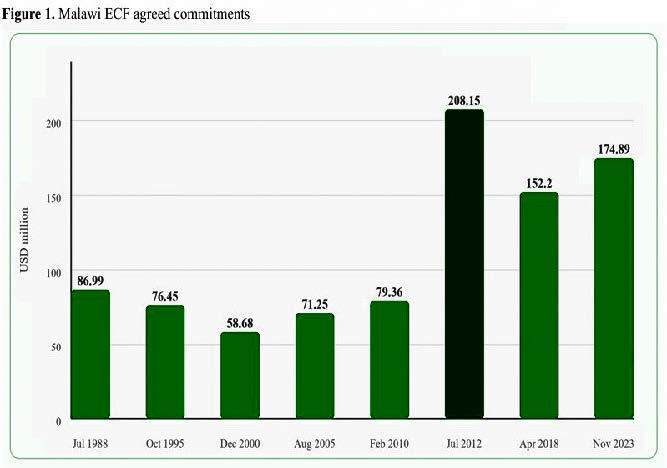
Ecama said performance under the Extended Credit Facility (ECF) has been particularly challenging, with only two programmes completed in the last two decades.
The organisation has since urged government to treat programme completion as the core objective during negotiations with the fund underway until June 18, warning authorities against politically difficult reforms to secure an initial disbursement, emphasising on the need to sequence reforms realistically.
Reads the brief in part: “Approval of a new ECF programme would be a significant milestone.
“However, completion of the programme would represent a significant transformation in economic management.”
The IMF mission is in Malawi from June 9 to 18 to discuss a possible new ECF after the previous four-year $175 million (about K306 billion) arrangement expired in May 2025 after running for 18 months without review.
Malawi secured the collapsed IMF deal to stabilise the economy by unlocking direct budget support from multilateral institutions such as the European Union, the World Bank and the African Development Bank.
In an interview, Minister of Finance, Economic Planning and Decentralisation Joseph Mwanamvekha said government is seeking a “win-win” agreement with the IMF that supports economic recovery while protecting vulnerable households.
“We will not accept any reforms that will harm the very people we want to protect,” he said.
Under the collapsed ECF, the Malawi Government implemented a series of reforms that Capital Hill said were tough, but necessary to convince development partners that it was committed to revitalising the economy, including raising the policy rate and devaluing the kwacha.
Reform efforts under the collapsed ECF focused on returning the country to a sustainable fiscal path, rebuilding external buffers, restoring debt sustainability and external viability while mitigating the effects of El Niño-induced shocks.
At the time of the ECF’s termination in May 2025, inflation rate was recorded at above 30.7 percent and foreign exchange shortages were at less than one month of import cover.
IMF resident representative Nelnan Koumtingue earlier said that the global lender remains fully committed to supporting Malawi’s reform efforts through constructive and solutions oriented policy dialogue.
The IMF Executive Board approved Malawi’s collapsed ECF on November 14 2023 to support the country’s efforts to restore macroeconomic stability and achieve a sustainable, poverty reducing growth.
Malawi sought the new ECF after cancelling the previous arrangement in September 2020 barely two months after the Tonse Alliance administration led by Lazarus Chakwera ascended to power.
Following the cancellation, Malawi forfeited $70 million (about K122 billion) and total access under the cancelled three-year ECF was about $145 million (about K254 billion), including the initial $112.3 million (about K197 billion) approved in April 2018 plus $40 million (about K70 billion) under Augmentation of Access approved in November 2019.
ECF is a medium-term IMF lending arrangement designed for low-income countries facing prolonged balance of payments difficulties. The programme typically provides concessional financial support alongside policy reforms.