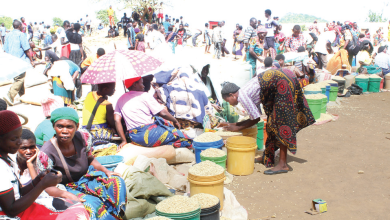
Farmers get raw deal, forced to sell maize below recommend price

Maize is retailing below the government-mandated minimum farm gate price of K1 050 per kilogramme (kg) in most produce markets across the country, a situation farmers say is worrisome.
However, grain traders have justified the lower prices being offered, saying the moisture content is still high.

According to published International Food Policy Research Institute (Ifpri) data, maize was retailing below the government-mandated minimum farm gate price in 21 of the 26 monitored markets by the end of April, posing a serious challenge for many smallholders who rely on maize sales immediately after harvest for a substantial part of their annual income.
“A delayed lean season response, under which maize continued to be distributed for free throughout the country despite the ongoing harvest, likely also contributed to the decline in prices,” said Ifpri in its recent maize market report.
During the month under review, retail prices of maize fell by 21 percent to K967 per kg from K1 221 per kg the previous month due to the arrival of newly harvested maize on the market.
The Southern Region continued to experience the highest average prices (K991 per kg in the last week of April), followed by the Central and Northern regions (K969 per kg and K888 per kg, respectively).
Significant reductions were recorded in Chitipa (K783 per kg), Jenda in Mzimba (K721 per kg) and M’baluku in Mangohci (810 per kg), where maize prices fell by 30 percent.
In an interview on Tuesday, Grain Traders Association of Malawi president Grace Mijiga Mhango confirmed that in most markets, the prices being offered are lower as maize has moisture content as high as 20 percent.
She said: “In this case the farmer is benefiting. We have noted with some traders who had started buying that their maize is now becoming discolored which will end up in losses.
“You will note Admarc has resources but failing to buy due to high level of moisture content. We still receive quite a lot of rains contributing to high humidity.”
On her part, Farmers Union of Malawi president Manes Nkhata said this is worrisome considering that the same farmers that are selling maize at a cheap price now will soon be buying the same at a high price.
She said it is very unfortunate that government struggles to enforce its own minimum farm gate price.
Said Nkhata: “Considering that most of them have seasonal purchasing power, they will eventually be expecting food support from the government or development partners.
“In the absence of the enforcement mechanism, FUM advocates for timely opening of Admarc markets so that it should act as a market leader in implementing the minimum farm gate prices that are set.”
In March this year, Agricultural Development and Marketing Corporation chief executive officer Dan Makata said the State grain trader will start buying maize this month with an initial target of 70 000 metric tonnes.
As part of food, maize contributes about 53.7 percent of the consumer price index, a basket for computing inflation.
In recent months, Malawi’s inflation has been on the rise, mostly driven by rising maize prices.
Both the Reserve Bank of Malawi and Ministry of Finance and Economic Affairs expect inflation, which averaged 32.3 percent in 2024, to drop this year due to improved agricultural output.