Thyolo farmers are toning down on maize growing to tee up generational wealth through a leaf long restricted to colonial-era estates in their vicinity, our Staff Writer JAMES CHAVULA reports.
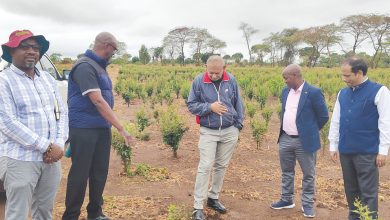
When the first rains descended on Mlenga Village in Thyolo District last October, Alex Magilasi biked 10 kilometres to plant tea in his hilltop maize field.

Tea rows split maize ridges in the field, the size of a football ground.
“Tea is more profitable than maize,” he says. “When I harvest the maize for food, I’ll slash the stalks to cover the soil and conserve moisture so that my tea does not wilt in the dry season.”
This rainy season, Magilasi planted 12 000 tea seedlings, the largest of its kind, with support from the government’s flagship Agriculture Commercialisation (Agcom) project. The remaining 7 000 are planted downhill.
“This is a big leap for me,” he recounts. “I started off with 500 plants in 2020, then added 2 500 in 2021, none in 2022, about 3 000 in 2023 and 1 500 in 2024.”
His growing tea fields illustrate local farmers’ switch from maize to the leaf once restricted to sprawling colonial-era plantations.
Magalasi belongs to Msuwadzi Tea Association in Thyolo District, which has expanded from 192 members to 319 since its inception in 1972.
The group was among the pioneers of the national initiative to ensure local Malawians get a share of tea production, the country’s third -largest export.
The most loved drink after water is blamed for pushing locals to rocky, barren and clustered hilly settlements in Thyolo and Mulanje districts.
Last year, the association, comprising 174 women and 145 men, won a K189 million matching grant from the $326 million Agcom to buy high-yielding tea seedlings and a pruning machine.
The project, funded by the World Bank, Multi-Donor Trust Fund and Global Multi-Umbrella Trust Fund, remitted a K74 million instalment last year.
“Tea is a long-term investment, that’s why we came together to collectively identify inputs, extension services and markets,” says Msuwadzi Tea Association vice-president Mark Mkanda.
The locals’ inroads in tea production started with seedlings that the government shared to give locals a stake.
For decades, they have been relying on seedlings from tea estates in the vicinity, but they were hardly enough for their ambition to increase their share and earnings.
“As maize yields are falling due to barren soils and climate change, diversifying to tea is the way to go. So, we wrote a proposal to Agcom to boost access to high-yielding tea seedlings and buy a pruning machine. We are excited that the proposal was approved,” says Mkanda.
The tea association contributed 30 percent in cash or kind to trigger the matching grant.
“For the first time, each farmer got at least 3 000 seedlings. Previously, estates could only provide 200 to 500 per farmer unless you could afford some more,” says Mkanda.
Magilasi increased his crop to 19 500 in five years.
“I want to own a large tea estate. This isn’t a hand-to-mouth activity like maize production, but a long-term investment which will lift my family, the children of my children and their children out of poverty,” he says.
The making of intergenerational wealth is unmistakable in the tea fields of Thyolo and Mulanje, where planters still reap the benefits of plots harking back to the early 1900s.
In the surrounding communities, locals lament worsening hunger and widespread poverty due to shrinking land size per person, barren soils and climate change.
Every morning, thousands leave their clustered villages to prune and pick tea, making the estates the country’s largest employer, second only to the government.
In their murmurs on the march to work for their fortnightly pay, the locals can only envy the proceeds of the world’s most loved drink after water.
“Our tea fields are growing gradually. Before the matching grant, we had 96 hectares belonging to 319 farmers. Agcom has helped us expand the cropped area to 116, up by 20 hectares. This is no mean achievement,” he says.
Msuwadzi Tea Association, which produces 800 tonnes annually.
They hope to reap 1 400 tonnes, almost doubling its earnings. It sells their tea to Satemwa Tea Estate at K298.84 per kilogramme.
“But we are negotiating for better prices with our trusted buyer,” says Mkanda.
The group will use the remaining grant to purchase a pruner intended to ease labour demands as the hectares increase.
“In our association, we are all equal and we are growing together,” says
Maria Mphuka, secretary of a committee of four men and seven women, has doubled her tea crop to 2 000 plants.
“Tea is a gift that keeps giving. I aim to become a self-reliant farmer, earning at least K1 million annually. I want to create wealthy generations, not just our daily food. Through this, I can guarantee my children decent meals, clothes, savings and education,” she says.