You have seen them doing it with a smile, proudly mingling while breastfeeding their babies in public with pride.
This is how your mother might have raised you or her mother loved to feed her.
The stuff seldom seen in open spaces where your modern-day lactating woman hangs might sound old-fashioned, but the shifting culture amplifies calls for friendly spaces for breastfeeding.
“Flapping breasts to feed babies in public is discomforting and obscene,” says Anesi Bitoni of Mbayani Township in Blantyre, 23.
The young businessperson, who prefers calling herself a hustler, gives her daughter bottled milk and juices all day.
“I only breastfeed her at home after knocking off due to work demands and privacy issues,” she states. “Exposing my breasts is like going naked in public.”
Health experts require a mother to exclusively give a baby breastmilk for the first six month before complementing it with soft foods for up to two years.
The World Health Organization (WHO) reports that breastfeeding gives the child all essential nutrients for a healthy start and immunity to diseases.
The breast, as sensitive as it can get, is central to the promised health benefits.
However, a picture of breastfeeding women in the street, shops, markets and workplaces is not a common sight in Malawi. Here, young mothers, celebrities and other influencers are seldom seen breastfeeding publicly and proudly even though exclusive breastfeeding constitutes a national investment in quality early childhood development, which lays a foundation that no medicine, vaccine or formula can replace later.
Unicef executive director Catherine Russell and WHO director-general Dr Tedros Adhanom Ghebreyesus term breastfeeding “a sustainable start in life”.
Reads their joint statement: “Scaling up breastfeeding could prevent almost 400 000 child deaths and around
140 000 maternal deaths each year.
“Every $1 invested in breastfeeding promotion generates an estimated $59 in economic returns through lower health-care costs, improved cognitive development, higher educational attainment, and increased lifetime earnings.”
The estimates show that individuals, governments and institutions that support a lactating mother with correct information, time, safe spaces at work and at home and open minds help build healthier, smarter and stronger nations.
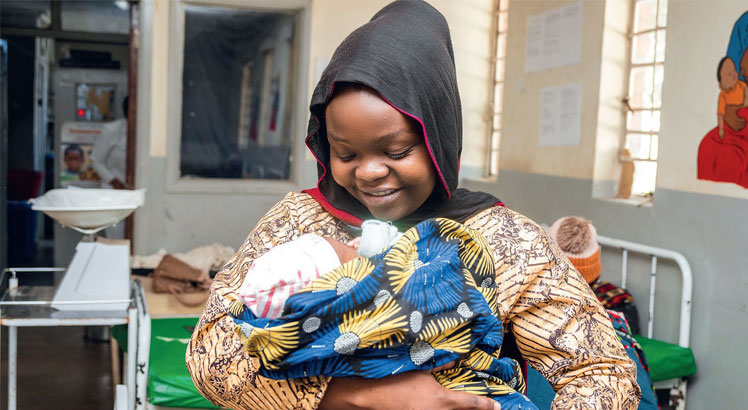
In the maternity wing of Queen Elizabeth Central Hospital in Blantyre, women sit with their chests exposed as they breastfeed their newborns.
Each mother represents the first contact to support a child and breastfeeding strengthens not only bonding, but also the child’s nutrition and immunity to diseases.
In the group, 23-year-old Janet Jonah, of Chirimba Township who works as a house cleaner in Nyambadwe within Blantyre, regrets that she only breastfed her first child for three months.
“I was back to work, from 6am to 5pm,” she says, caressing her second-born. “I am not allowed to bring my child to work. I leave her with my in-laws until I clock out from work.’’
Jonah says a little time off during the day would help her feed baby Tadala differently.
Women in business and workspaces are often forced to keep their breasts not just from the public eye, but also from the newborns who need it.
A mix of shame and workplace rules that defy health policies frustrate those who would want to feed their children at work and on the move.
Some mothers resort to bottled milk, which sometimes perish or get contaminated before reaching the child’s mouth. Others introduce babies to fizzy drinks, denying them nutritious food for a healthy life.
However, healthcare advocates Dr Bridget Malewezi and Florence Bwanali stress that formula cannot substitute the nutritional value, immunity and mother-child bonding that breastfeeding provides.
In 1992, the United Nations set aside the first week of August to promote health benefits of exclusive breastfeeding.
Yearly, governments and partners bombard women with key messages: breastfeeding saves lives, protects health, builds brains and costs nothing.
Minister of Health Madalitso Baloyi said the same when she launched the annual campaign in Lilongwe this month.
“Breastfeeding is one of the most effective interventions we have for preventing child deaths, malnutrition and diseases. It provides all the nutrients and fluids infants need in the first six months of life, protects the baby against diarrhoea and pneumonia and supports brain development and future school performance,” she stated.
However, what often goes unsaid in policymakers pronouncements is that mothers cannot do it alone—they need support and policies that create safe spaces for the sustainable start every child deserves. However, there is no stocktake is done to measure progress in the demolition of age-old barriers.
This year’s national theme, ‘Pioritise breastfeeding: create sustainable support systems’ calls on everyone to strengthen what works as every child deserves a healthy start.
What works is not new. It is the breast some women feel shy to expose in public.
However, the proportion of children who enjoy exclusive breastfeeding within the six-month window has dropped from 72 to 60 percent since 2010, shows the 2015 Malawi Demographic and Health Survey.
Last year, then secretary for health Samson Mndolo warned that some mothers fail to breastfeed because they are denied of an enabling environment. He asked employers to provide breastfeeding shelters and breaks in workplaces.
The call echoed throughout this year’s commemoration, but with little to show for the required policy shift.