The major urban roads of Lilongwe, Blantyre, and Mzuzu are facing an accelerating environmental crisis and spatial chaos.
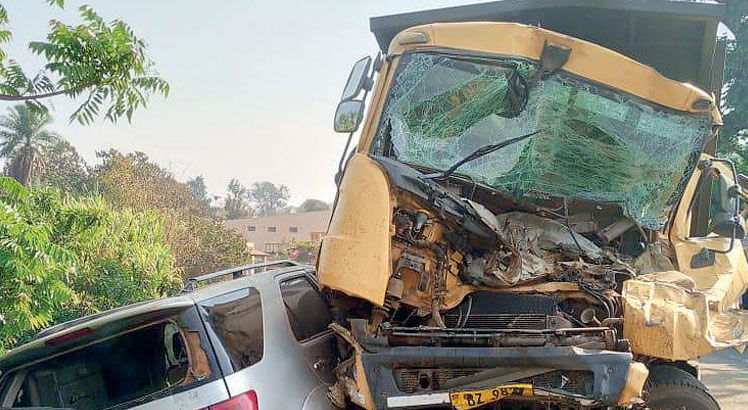
Unregulated car graveyards are multiplying and expanding across public land, especially strips reserved for roads’ expansion.
Rather than operating as temporary scrapyards or functional car breaking sites, these locations have been allowed to degenerate into permanent repositories for dead vehicles.
Here, the rusted corpses of automobiles are abandoned indefinitely on public grounds and protected road reserves.
The scale of the encroachment is stark, with 42 car gravesites mushrooming on the edge of a single six-kilometre stretch of Chidzanja Road that passes through Biwi , Kaliyeka and Kawale townships in the capital city.
These commercial operations occupy and take over vital road reserves explicitly set aside for pedestrian safety and future infrastructure development.
This severe concentration of stripped chassis and shattered windscreens are increasingly transforming vital public roads into a persistent nuisance and a grotesque eyesore.
If left unchecked, the practice threatens to permanently alter Malawi’s rising urban centres into graveyard cities where public health, civic pride, law and order die in plain sight.
Yet, this severe state of negligence, lawlessness and decay masks a massive economic paradox. The old vehicles rotting for spare parts along Chidzanja Road alone holds an estimated market value ranging from K7 million to K560 million.
Currently, a lucrative and aggressive new trend has emerged within the informal sector. Automotive breaking dealers are now actively dismantling newly imported reconditioned vehicles bearing “In Transit” (IT) labels to cover the supply gap for spare parts of the latest car models.
Traders are generating far higher profit margins by breaking these vehicles down than by selling a whole car to consumers. For instance, a single four-hole, 15-inch rim fetches nearly K300 000, highlighting the immensity of money circulating within this shadow ecosystem.
Crucially, this perspective does not seek to vilify the informal economy of the secondhand spare parts business. The traders provide essential, low-cost components to motorists and sustains thousands of livelihoods across the country.
Instead, the blame lies squarely with urban councils sleeping on the job. By failing to govern public space and to protect road reserves, city council allow a vital economic sector to operate as an environmental hazard, as the nation faces a grim future where heavy metals and toxic chemicals irreversibly poison cities and towns without any checks and balances.
The State possesses immediate legal remedies to avert this public health and environmental hazard.
Section 56 of the Environmental Management Act outlines the dos and don’ts when it comes to waste management.
Among others, the law, passed in 2017, requires any entity handling, storing or generating non-domestic waste must possess a valid waste management licence issued by the Malawi Environment Protection Authority (Mepa).
Unlicensed car graveyards operating within urban road reserves violate this legal requirement, continually leaking battery acid and hazardous fluids into local groundwater.
Yet Section 50 of the Physical Planning Act of 2016 provides for a clearance order that authorises the immediate removal of these roadside encumbrances from protected road reserves.
Additionally, Section 61 on special area declaration empowers the State to designate structured automotive yards for these written-off vehicles outside urban centres. Such sites could be created 30 kilometres away from the city centre.
International best practices demonstrate that economic survival and environmental health can successfully coexist.
In Belgium, car gravesites are strictly designated and licensed, allowing locals to access affordable spare parts to repair their vehicles in clean, organised environments without encroaching on public walkways. In Manila, Philippines, recovered and junked vehicles are legally restricted from public view and routed directly to serviced sites or designated zones far from residential areas and road reserves.
Malawi must decisively adopt and enforce strict and structured laws and policies.
Local councils need to formalise and incentivise operators to transition from unorganised roadside dumping to structured automotive zones.
This transition requires reviving the oversight of town rangers, who are largely absent today, to monitor public streets and report violations to municipal councils. The councils must then write directly to the minister responsible for lands for immediate cleaning and clearance orders.
Meanwhile, planning authorities must develop designated industrial automotive zones equipped with concrete flooring, oil-water separators and proper drainage to catch hazardous fluids.
City councils should also establish simplified licensing programmes paired with mandatory training on safe fluid extraction, battery recycling, and scrap handling. This support will help informal operators transition into compliant, legal entities.
Finally, cities must enact and enforce strict by-laws to permanently curb roadside dumping on vital public infrastructure.
Enforcement of city by-laws through mandatory vehicle impoundments, collaborating with private scrap processors and mandating environmental management training, will help Malawi safeguard both its economic millions and its urban future.