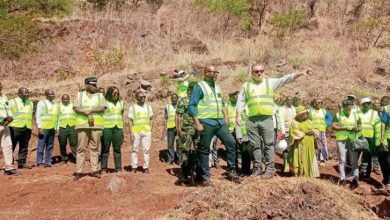
China has embarked on yet another grand project in Lilongwe—the construction of the judiciary complex.
It will be the headquarters of Malawi’s Judiciary, a bastion of justice and democratic governance.
The facility is taking shape opposite the Parliament Building, another imposing structure sponsored by China.

This support to the two arms of government positions China as a partner willing to support Malawi’s democracy despite the popular perception that the Asian giant has little to do with democratic governance.
But China dismisses such perception as mere propaganda, identifying itself as a democratic system that has achieved unprecedented economic growth.
Associate Professor Boniface Dulani, a political scientist from the University of Malawi (unima), argues that China’s support for the Parliament and judicial complexes is more about supporting what amplifies its presence in recipient countries.
“I would not read so much into the so-called political symbolism, but what China intends to achieve. These projects are pitched and China is just responding to what is requested,” he said in an interview.
To Dulani, it is for the same reason the Chinese supported the construction of the African Union headquarters in Ethiopia.
“Through such infrastructure, China has penetrated space to its advantage,” he argued.
Dr Michael Jana, a political and international relations scholar at the Wits University in South Africa, observes that China is not necessarily supporting “democratic governance from an ideological perspective”.
He states: “One fundamental principle about aid is that aid is an instrument of foreign policy by the ‘donor’. This principle applies whether aid is from the East or the West.
“This means that Chinese aid is part of its foreign policy to strengthen its international geopolitical and economic position.”
Next to the Parliament and Judiciary buildings in Lilongwe is the Chinese-aided Umodzi Park which houses the five-star President Hotel, Bingu International Convention Centre (Bicc) and Malawi Square as well as presidential villa short distance away.
The capital city is also home to the Chinese-funded presidential villas, Bingu National Stadium (BNS) and the dual-carriageway road project.
China is financing the construction of a dual-carriage way from Crossroads Roundabout to Kanengo in Lilongwe.
Outside the capital city, there is the Malawi University of Science and Technology (Must) in Thyolo and the Karonga-Chitipa Road, which China completed soon after Malawi switched ties from Taipei to Beijing.
Jimmy Kainja, a media and cultural studies lecturer at Unima, argues that China’s actions reflect a strategic blend of development support and soft power diplomacy.
He says by funding key infrastructure projects in partner countries, China signals that it is a non-conditional, constructive partner committed to state-building and institutional development.
“Additionally, China’s practice of prominently branding its aid as “China Aid” serves multiple purposes. It enhances both domestic and international legitimacy, reinforces its image as a benevolent global actor, and strategically frames its assistance as pragmatic and free of ideological strings,” Kainja reasons.
He further indicated that “this high visibility helps foster long-term influence, potentially translating into diplomatic support and alignment with Chinese interests”.
Jana says while Malawi has benefitted from its ties with Beijing, China has gained access to a new market, providing business and work for their labour force and industries.
“The emergence of China as a donor has provided developing countries with more resources and options, has strengthened their negotiating power, and speeded up some development projects. But in international relations, that includes the aid regime. There is no free lunch,” he said.
Before China’s arrival, Malawi’s main development partners were largely from the West.
But Kainja further points out that the recent announcement of US aid cut gives China an opportunity to assert its influence in aid-dependent nations.
“The future of China-Malawi cooperation holds great promise,” said Lu Xu, the new Chinese ambassador at a reception held two weeks ago.