Eighteen months after Parliament passed a law to regulate Malawi’s property market; the delay to operationalise the industry regulator has left desperate house hunters exposed to rogue agents, cloned property adverts, scams and non-refundable viewing fees.
For Sylvia Mbwana, that regulatory failure has come at a personal cost.
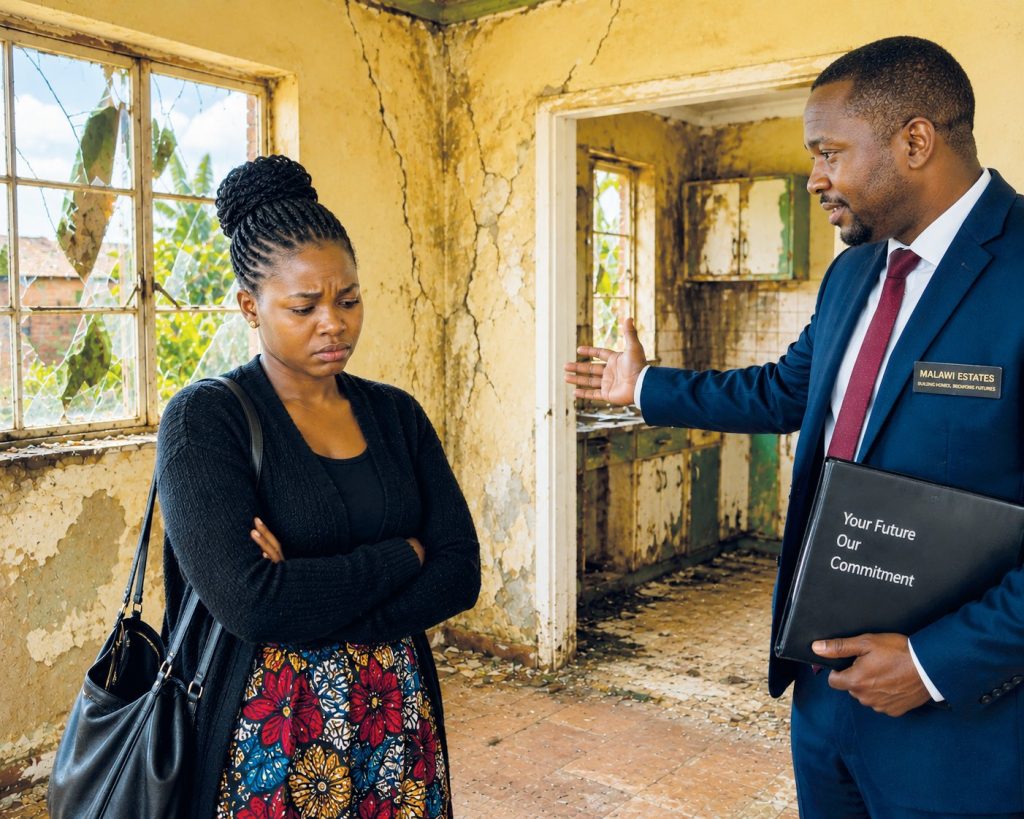
For five months, she searched for a house costing between K150 000 and K200 000 in Lilongwe’s Biwi, Kawale, mchesi and Area 36. Instead of finding a home, she lost K50 000 in viewing fees after being taken to substandard and insecure properties.
“At first I was desperate and thought I would find something quickly,” she said
“But I kept paying to view houses that were far below standard. In the end, I gave up and moved in with a friend while waiting for a miracle.”
Her experience mirrors that of hundreds of prospective tenants navigating an increasingly lawless rental market.
Although the Real Estate Management Act came into force on January 13 2025, the Real Estate Management Council (Remac)—the body established to license practitioners, enforce standards and discipline rogue agents—remains largely non-operational.
More than a year later, the council has no operational board, no fully functioning secretariat, no gazetted regulations and no established office. Following the dissolution of parastatal boards by the new Democratic Progressive Party (DPP) administration, the structures needed to enforce the law are still not in place.
The consequences are now playing out in cities across the country.
Industry players say cloned property advertisements, fake listings, disappearing deposits and exploitative viewing fees have become increasingly common, especially in Lilongwe and Blantyre, where desperate tenants often have little choice but to pay.
A tax on desperation
For many house hunters, the biggest obstacle is no longer raising a rent deposit but paying non-refundable viewing fees that have effectively become an unofficial tax on desperation.
Across informal property networks operating mainly through WhatsApp and Facebook, prospective tenants routinely pay between K20 000 and K25 000 simply to inspect a house.
McPherson Banda, who relocated from Balaka and is temporarily staying with relatives in Lilongwe’s Area 18, has spent K120 000 on viewing fees since April.
At one point he handed an agent K350 000 intended as a deposit, only to discover the advertised house was already occupied. Although the deposit was eventually returned, the viewing fees were lost.
“Finding a house in Lilongwe has become a nightmare,” Banda said. “These agents prey on desperate people.”
For low-income earners, the losses are crippling.
Minibus conductor Nafy Chipala from Likuni said every failed viewing pushes his family further into hardship.
“Every time I pay K20 000 or K25 000 and that is not small money. That is food, transport and savings for my family disappearing in a single day.”
He said many advertised properties either do not exist or bear little resemblance to what agents promise.
“Sometimes you are shown a house that is already occupied or one that looks nothing like what was advertised. But the viewing fee is never refunded.”
The pattern is repeated elsewhere
Blantyre resident Steven Nkhoma previously told Weekend Nation he spent months moving among Kanjedza, Chigumula, Soche, Chiwembe and Namiyango, paying K10 000 viewing fees and 40 percent commission for properties that failed to match their descriptions.
In Mzuzu, Henry Malata said he paid up to 50 percent commission and K20 000 in viewing fees before finally securing accommodation.
Market ripe for abuse
Knight Frank Malawi managing director Desmond Namangale said the absence of effective regulation has created ideal conditions for exploitation.
According to Namangale, informal agents routinely clone legitimate advertisements, fabricate property listings and collect deposits before disappearing.
“The clearest evidence is the intense competition for available houses. Several people are often interested in the same property, creating opportunities for unscrupulous operators to exploit the market.”
He said the fraud is also damaging legitimate property businesses by undermining public confidence.
“Widespread scams make buyers and tenants increasingly suspicious of the market, affecting legitimate firms.”
In a WhatsApp response, Namangale said unlicensed agents exploit desperate prospective tenants by charging multiple viewing fees, cloning genuine adverts and collecting deposits for non-existent properties.
He added that tenants are frequently forced to shoulder the entire agency commission while landlords pay
nothing.
Namangale said Remac should urgently establish clear rules governing agency representation, standardise commissions and eliminate unlicensed operators.
Real estate consultant Prince Matchika argued that rogue agents are exploiting a much deeper structural problem—a chronic shortage of urban housing.
He said soaring construction costs, limited serviced land and rising demand have created conditions that leave tenants vulnerable.
“Low-income families struggle to find affordable accommodation, first-time buyers cannot keep pace with rising prices and even middle-income households are finding it harder to upgrade.”
While acknowledging that informal brokers have taken advantage of the situation, Matchika said the long-term solution lies in expanding affordable housing and wider implementation of the Sectional Titles Act to maximise urban land use.
Rules of the cartel
In the absence of State regulation, informal property networks have effectively written their own rules.
Weekend Nation reviewed guidelines circulated in online housing groups prescribing standard viewing fees of K20 000 in rural areas and K25 000 in urban centres, alongside a non-refundable commission equivalent to 50 percent of the first month’s rent.
For Area 49 primary school teacher Ruth Banda, those unwritten rules have turned house hunting into an emotional and financial ordeal.
After spending more than K60 000 on transport and viewing fees, she remains without a home.
“Each time I hoped I had finally found the right house, I would discover broken windows, no fence or an outside toilet. Eventually, I felt embarrassed even calling the agent back. You keep paying but remain homeless.”
The guidelines reveal a system that rewards agents regardless of whether tenants secure accommodation. Viewing fees are non-refundable, commissions are often demanded even after failed searches and tenants have virtually no recourse once money changes hands.
Remac chief executive officer Sarah Kauta Chauma acknowledged that the council has yet to begin full operations.
“It was established in May [last year], but has not started operations because the secretariat has not secured office space and staff recruitment is yet to be done.
“Additionally, we are waiting for the Ministry of Lands to formulate regulations that will guide our operations.”
She said the council will register practitioners, eliminate unlicensed agents and restore order once it becomes fully operational.
The Real Estate Management Act was enacted to protect consumers by regulating practitioners and enforcing professional standards.
The Ministry of Lands had not responded to questions by press time.