A former Ministry of Health accountant Felix Mugonya has been battling for justice since a brain surgery he underwent at Queen Elizabeth Central Hospital (QECH) in 2017 to remove a swelling rendered him blind.
Mugonya’s wife, Mirriam Kambona, complains that following the surgery, her husband is now destitute and broken, and also that his children are unable to continue with their education due to lack of funds.
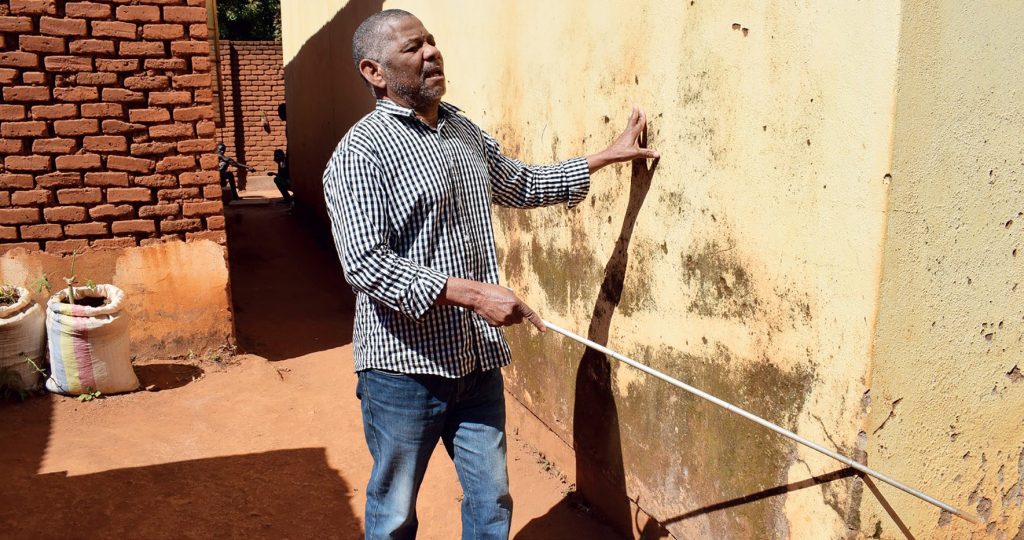
She recalls how news of her husband’s blindness was broken to her, and the hassles the family has gone through.
Said Kambona: “After undergoing the operation at Queens following years of battling with the illness, the doctor called me aside and advised me to calm down and accept my husband’s situation and to give him care and love as he won’t be able to see again.”
The loss of sight marked a tragic turning point that would leave Mugonya destitute and desperate for justice. He has since been pushed from pole to post in pursuit of justice.
Suspecting negligence in how he was handled during the medical procedure, Mugonya and his wife lodged a complaint with Medical Council of Malawi against neurosurgeon Dr Patrick Kamalo.
But the council’s decision, articulated in a letter to Mugonya dated May 9 2022, acknowledged that while Dr Kamalo had treated Mugonya in accordance with the standards of practice—given the complexity of his case—the surgeon failed in one critical area: obtaining and documenting informed consent.
However, according to the letter to Mugonya we have seen, the council determined that Dr Kamalo was not guilty of medical negligence but emphasised that hospitals, including QECH should adopt standardised consent forms that include key elements such as describing the procedure, discussing risks and alternatives and confirming patient’s understanding, and observed that Mugonya’s case was not isolated.
“The Ministry of Health, Medical Council of Malawi and other relevant stakeholders should develop and implement appropriate consent forms for all hospitals to mitigate such cases.”
In a phone interview, Medical Council of Malawi registrar Dr Davies Zolowere said the council’s disciplinary committee found Dr Kamalo not guilty because he followed procedures.
Zolowere explained: “We asked Mugonya to appeal the determination at the court, if he felt not satisfied with it.”
Following these findings, on August 31 2021, Mugonya engaged lawyer Oscar Taulo of Taulo and Associates, to represent him.
In documents we have seen, Taulo assured Mugonya, that he had written and discussed with the Attorney General about Mugonya’s issue.
On March 10 2023, Taulo filed a civil suit titled ‘Between Felix Dowele Mugonya as Claimant and Dr Kamalo as 1st Defendant and Attorney General
(Ministry of Health) as 2nd Defendants’ in the Lilongwe High Court.
Mugonya said Taulo’s communication with them became erratic.
Frustrated and feeling abandoned, he took his grievances to the Speaker of the National Assembly, Catherine Gotani- Hara, with copies to the Health and Legal Affairs Committees of Parliament.
Responding to our questionnaire, Parliament spokesperson Ian Mwenye said Parliament had not yet received Mugonya’s letter.
He said: “ Once it is received, we will make a decision on how best the person can be assisted.”
But Kambona claimed she has been talking to Gotani-Hara through phone calls and WhatsApp and the Speaker promised to help her. We could not independently verify her claim with Gotani-Hara.
On February 6 2025, Mugonya lodged a complaint with the Malawi Human Rights Commission (MHRC) through its executive secretary Habiba Osman. She copied the complaint to Malawi Law Society former president Patrick Mpaka.
Mugonya claims that to-date MHRC has not helped her.
Following our call to Taulo, he allegedly sent a voice note to Mugonya informing him that he had ceased to represent him.
Responding to our questionnaire, Taulo said: “I have always picked their calls and communicated the progress of the case to them. We did everything on the matter, even the Human Rights Commission has engaged the court for a date but no date has been issued yet.”
Kambona said when she went to Taulo’s office, he asked her to append her signature to a form he handed her to confirm that she had asked him to cease representing her husband in the case.
“The truth is that it is him who decided to cease to represent my husband and not the other way round.”
Kambona further said when she visited the court to look for her husband’s file as per Taulo’s claim that he had sent it to the Legal Aid Bureau, a court clerk whom she did not name told her that the Attorney General provided the court with government’s defence and that the case was to go for mediation.
“The clerk further told me that the Attorney General has now applied for the dismissal of the case and the court is yet to give a date for that,” Kambona said.
Mugonya’s story is a heartrending narrative of medical misfortune, institutional neglect and the elusive pursuit of justice—raising pressing questions about accountability, systemic failures and the urgent need for reform in Malawi’s healthcare and legal systems.