Malawi’s State-owned enterprises (SOEs) are costing the economy an estimated K640 billion a year, an equivalent of two percent of the gross domestic product (GDP) through subsidies, highlighting growing fiscal risks from financially troubled public firms.
The World Bank, in its biannual Malawi Economic Monitor unveiled in Lilongwe on Thursday, said the costs arise from quasi-fiscal activities, including instances where public enterprises provide goods and services below cost-recovery levels, with the resulting financial burden reflected in debt accumulation, deferred investment and declining service quality.
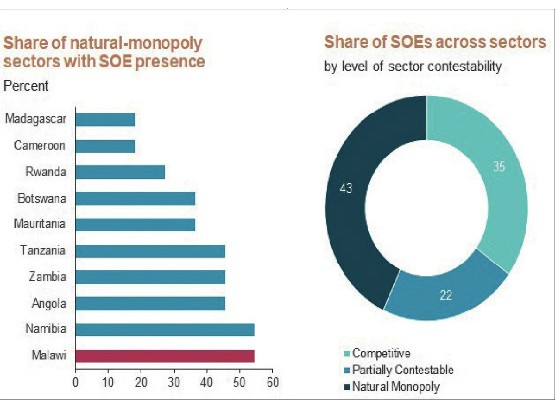
The findings are contained in a special analytical chapter titled ‘Reforming State-owned enterprises for better services’, in the 23rd MEM.
The report shows that the SOEs sector has expanded significantly, with total assets rising from 14 percent of GDP in 2019 to 26 percent in 2024 while revenues increased from eight percent to 11 percent.
But the expansion has not produced corresponding improvements in performance, according to the report.
“Asset expansion has not translated into improved financial performance or service delivery, highlighting a widening disconnect between the sector’s scale and its effectiveness,” reads the report in part.
The Bretton Woods institution said many SOEs remain financially weak or dependent on State support, with weak cash flows, poor debt-servicing capacity and declining dividend contributions to the government.
Beyond the subsidies, The Nation’s analysis of government’s 2025 Consolidated SOEs Report shows that commercial entities received K292.17 billion in government grants between 2022 and 2025.
The two figures measure different forms of support, with K292.17 billion representing government grants over four years while the estimated K640 billion reflects the annual value of subsidies associated with quasi-fiscal activities based on the two-percent-of-GDP estimate.
Speaking duirng the launch, Minister of Finance, Economic Planning and Decentralisation Joseph Mwanamvekha acknowledged that SOEs remain “financially weak and operationally inefficient”, but said reforms have to recognise the social functions some public enterprises perform.
He said government intends to pursue reforms that improve the financial position of the enterprises while protecting vulnerable consumers who depend on their services.
National Smallholder Farmers Association of Malawi chief executive officer Betty Chinyamunyamu said the quality of services supplied by public utilities also has implications for productive sectors, with unreliable energy affecting irrigation, storage and other agribusiness operations.
In an interview on the sidelines of the launch, African Institute for Development Policy executive director Eliya Zulu said SOEs cannot be assessed in the same way as purely commercial enterprises.
“They are meant to help provide services that may not be easily provided by the private sector because they also have a social component,” he said.
Speaking during a panel discussions held at the launch, Public Finance Management director Monasyile Mhango said the financial performance of utilities has to be viewed against both commercial and social functions, citing water and electricity providers whose tariffs have to balance cost recovery with affordability for low-income consumers.
The World Bank, however, argues that such public-service obligations should be clearly separated from commercial operations and explicitly financed through the national budget instead of being concealed within SOEs operating losses.
Agriculture illustrates the problem. Government support to agricultural SOEs jumped from K27.9 billion in the 2024 to K118 billion in 2025, mainly to support food security mandates and input subsidies.
But the bank said social obligations alone do not explain SOEs financial weakness, pointing to technical and financial losses, overstaffing, weak revenue collection and governance problems.
Afrobarometer director of surveys Boniface Dulani said Malawi already has much of the institutional architecture needed to address the problem.
The report recommends enforcing financial reporting requirements under the Public Finance Management Act.