Deep in Ntchisi District, Kondwani Dayimoni, 25, was on the brink of abandoning his education due to worsening poverty amid falling crop yields.
His dilemma personifies a familiar plight of Malawians in rural communities where formal jobs are scarce and crop yields dwindle due to low-grade seeds, barren soils and climate change.
The country’s massive youth unemployment is a compounding crisis and dropping out of school usually signals a lifetime of subsistence labour.
Without collateral or a credit history, the 25-year-old was effectively locked out of the formal economy.
Today, however, Dayimoni is preparing to enroll at Domasi College of Education in Zomba, a gateway to his dream career.
“My tuition was financed entirely by a one-and-a-half-acre plot of soya beans, not a bank or loan sharks that trap most poor Malawians in poverty,” he brags.
The young man attributes his rise from poverty to the Pusha loan initiative, which marks a radical shift in how agricultural capital is disbursed to marginalised youth.
Through the initiative, backed by the Farmers Union of Malawi) and the Alliance for a Green Revolution in Africa (Agra), young farmers in Ntchisi District are bypassing traditional financial institutions entirely.
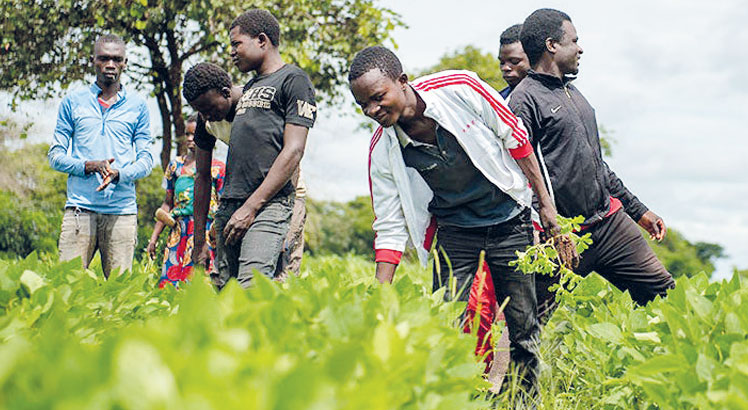
Instead of receiving cash, which is often swallowed by the immediate pressures of household poverty, participants receive their loans in the form of high-quality soya bean seeds.
The intervention is designed to absorb the financial risk that normally excludes young people from commercial agriculture.
It is transforming a sector long dismissed as a dead-end survival strategy into an engine for youth entrepreneurship.
The structural barriers to entering commercial farming are steep for young men, but they are often insurmountable for young women, who face intersecting prejudices from lenders.
Triphina Maliko is dismantling those assumptions.
After accessing a Pusha seed loan, she not only expanded her agricultural output but also invested her harvest profits to establish a mobile money business, creating a diversified safety net.
For Maliko, the Pusha initiative is about bumper crop yields and reclaiming space for the youth in a system that frequently writes off young farmers as high-risk investments.
“Farming has helped me become independent, and I want to encourage other young people, especially girls, to join,” she says.
Maliko urges her peers to organise and prove the institutional sceptics wrong.
“We should not take agriculture as a playground or something backward. This is serious business. We can actually benefit a lot from it and stop depending on parents.”
Providing seeds is only half the battle.
Smallholder farmers across the country are historically vulnerable to predatory buyers, unregulated middlemen who exploit farmers’ desperate need for cash immediately after harvest, buying produce at artificially suppressed prices.
To combat this, the Pusha initiative has rolled out a grassroots cooperative model.
In Dayimoni and Maliko’s village, Tazindikira Cooperative serves as an institutional off-taker—a trusted buyer.
It guarantees a ready market for the youth, purchasing their soya beans using reliable scales and strictly adhering to government-set minimum prices.
“We help farmers access markets so they do not struggle to sell their produce after harvest,” explains Alfonso Kachapira Banda, a representative from the cooperative’s marketing department. “This makes it easier for farmers to sell their produce, benefiting both the farmer and the cooperative.”
Violet Kamwaza, chairperson of Tazindikira Cooperative, notes that working collectively provides young farmers with a shield against exploitation while fostering a culture of peer-to-peer accountability and knowledge sharing.
The success in Ntchisi has prompted calls to integrate youth-focused, risk-mitigating financial models into national policy.
To agriculture extension officer Masautso Bamusi Phiri, empowering the youth through targeted financing is not merely a social good, but an economic necessity for the country.
He is urging stakeholders to work more closely with the Ministry of Agriculture to institutionalise accessible financing mechanisms like Pusha.
“Young people are an important component in achieving growth in agriculture,” Phiri says.
As Malawi navigates severe economic headwinds, the young farmers of Ntchisi are demonstrating that with structural support and protection from volatile markets, the next generation doesn’t have to abandon the land to find a future. Given the right seeds, they can grow their own.