The World Bank has hailed Malawi for executing the 2026/27 National Budget within approved limits for the first time in more than five years, describing the development as an important milestone in the country’s efforts to restore macroeconomic stability.
World Bank Group division director for Malawi, Tanzania, Zambia and Zimbabwe Firas Raad made the remarks in Lilongwe yesterday during the launch of the 23rd Malawi Economic Monitor (MEM) themed ‘Building stability to unlock growth’ with a special topic on ‘Reforming Malawi’s State-owned enterprises for better services’.
“For the first time in more than five years, the national budget is being executed within its approved limits, an important institutional achievement,” he said.
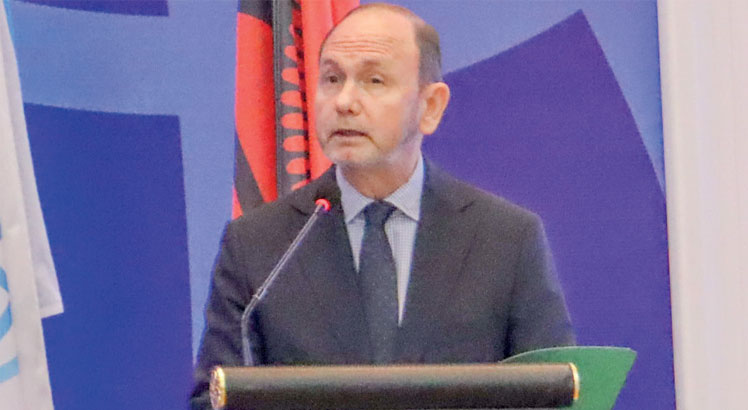
Raad, who until a few weeks ago was former World Bank country manager for Malawi, added that the primary fiscal deficit has fallen sharply from 3.7 percent to 0.4 percent of gross domestic product (GDP).
He said Malawi is showing early signs of economic adjustment, but these have not yet translated into a meaningful improvement in living standards.
GDP growth is projected at 2.7 percent in 2026, a decline from 2.5 percent in 2025, only marginally above population growth of about 2.6 percent.
Raad said persistent inflation, foreign exchange distortions, unreliable energy, weak domestic supply chains and a difficult business environment continue to constrain investment and productive activity.
He said growth remains insufficient to substantially increase incomes and create better-paying jobs.
The biannual report said that fiscal consolidation has started yielding results, with the overall fiscal deficit narrowing to 8.8 percent of GDP in the 2025/26 financial year supported by expenditure controls, tax reforms and stronger revenue administration.
“Fiscal consolidation efforts have begun to yield results, but public finances remain under severe strain,” reads the report, adding that large interest payments continue to absorb government revenues that could otherwise finance productive investment and social services.
But Raad said structural reforms have to continue and be sustained “prudently and steadily over time”.
In his remarks, Minister of Finance, Economic Planning and Decentralisation Joseph Mwanamvekha said government will continue to pursue reforms aimed at stabilising the economy, including negotiations for a new programme with the International Monetary Fund (IMF).
However, he stressed that the programme will reflect Malawi’s own priorities rather than being regarded as a package of reforms imposed by the IMF.
“We should create a programme not because the IMF has told us, but because we need to have a programme that we can own,” said Mwanamvekha.
He said reforms under such a new programme will be carefully timed and sequenced, with economic adjustment implemented in a manner that protects vulnerable households.
Thr report highlights an IMF-supported programme as an important potential anchor for Malawi’s economic stabilisation efforts.
The prevous four-year $175 million (about K306 billion) IMF programme collapsed in May 2025 after the Malawi Government failed to complete reviews for 18 months.
The World Bank report further said government’s five-year National Economic Recovery Plan has strengths, including broad coordination across government and a results-oriented framework aligned with Malawi 2063, but warns that some expansionary investment proposals conflict with fiscal consolidation objectives.
It said an IMF-supported programme could help “strengthen policy credibility, support fiscal discipline and unlock additional concessional financing”.
Despite the emerging gains, the bank said living standards remain under pressure, but national poverty has declined from 50.7 percent to 47.3 percent, with food poverty increasing from 20.5 percent to 24 percent, while inequality has worsened.
“These are not abstract statistics they represent millions of families working harder and earning less and young people unable to find work commensurate with their talent,” reads the report.
The MEM says sustaining fiscal discipline, addressing debt and foreign exchange market distortions and creating conditions for stronger private sector-led growth will be critical if the early stabilisation gains are to realise positive gains.