


At dawn, Lake Malawi glows golden Along parts of Senga Bay in Salima, however, the golden shoreline is slowly being dug away.
When you visit Kambiri Point, you will see piles of freshly extracted sand sit beside roads and properties, waiting for tippers to haul them to construction sites.
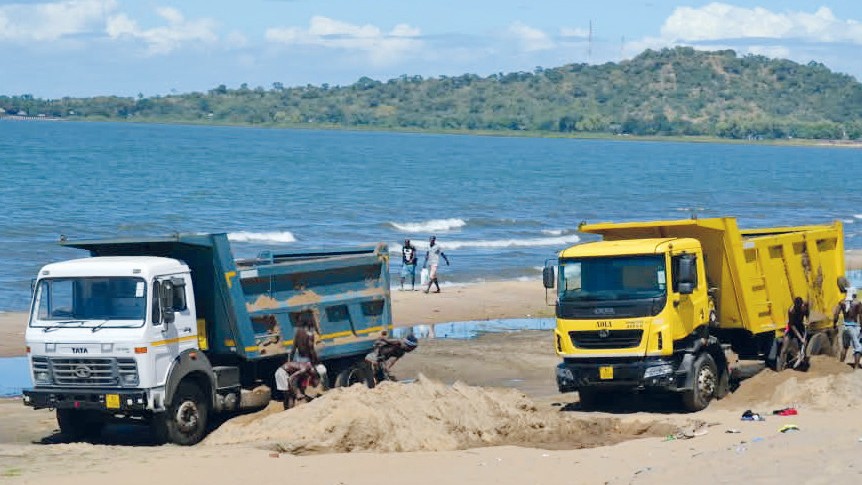
Where trucks cannot reach the beach, men carry buckets of sand from the shoreline to the roadside.
The digging leaves behind deep pits along the lakebed while some miners work before sunrise to avoid the heat and, according to people familiar with the activity, sometimes under the cover of darkness.
The scene is becoming familiar along sections of Malawi’s 560-kilometre lakeshore.
From Karonga at the northern tip to Monkey Bay in Mangochi, sand extraction is putting pressure on beaches, riverbanks and streams, raising concerns about what the country could lose if the trade continues unchecked.
Lake Malawi has been a Unesco World Heritage Site since 1984, recognised for its natural beauty, clear waters and exceptional freshwater biodiversity.
But the very clarity that makes the lake attractive to tourists depends on natural processes that can easily be disturbed.
Environmental activist Mathews Malata fears that if sand mining continues at its current pace, the lake could lose some of the qualities for which Malawi markets it to the world.
A 2007 study by Greg K. McCullough and colleagues found that sediment movement and settling are among the natural processes influencing Lake Malawi’s water clarity.
That matters because sand and other sediments are not simply material lying on the lakebed waiting to be removed.
They form part of the lake’s natural sediment system.
According to the study, when mining removes large quantities of sand, it takes material out of that system.
Digging,the study argues,can also disturb finer sediments, leaving particles suspended in the water and increasing turbidity.
In simple terms, a lake cannot maintain the same natural balance if material is continually taken out faster than it can be replenished.
“Any management strategy to tackle coastal sand mining must begin with understanding underlying processes,” said the study.
For the men digging the lakebed, however, the environmental argument competes with their survival.
Jafeti Kayisi, who works around Senga Bay, digs two to three metres into the lakebed using a hoe and shovel.
“It’s backbreaking as some of the sand we shovel is wet. But what else can we do to beat hunger and poverty as the rains are no longer predictable?” he says.
Kayisi’s story reflects the dilemma at the heart of the sand trade.
Construction companies and households need sand for building. Borehole projects require sand. Transporters make money moving it.
Intermediaries make money selling it.
And at the bottom of that chain are people like Kayisi, who depend on the lakebed for an income.
But the cost may be accumulating around them.
Senior Chief Maganga says communities living around the lake have experienced flooding while illegal sand mining continues despite the dangers.
She says that some miners arrive as early as 4am to begin digging.
Recently, a crocodile killed a woman who was collecting sand from the lake.
“Even with that, the mining has not stopped. As chiefs, we are also trying to stop it, but nothing happens,” she says.
According to the chief, most tipper trucks come from Lilongwe to collect sand for house construction, while some sand is used in borehole construction.
The question is who pays for what is left behind.
German tourists Phorebe Schroder and Emmi von Ploetz, from Berlin, have previously fauited the changing condition of Lake Malawi’s beaches and surroundings.
Protected, but still mined
Under the country’s National Land Policy, land within 50 metres of the lake’s high-water mark is recognised as public land and forms part of a protected lakeshore zone.
The Mines and Minerals Act provides that minerals in Malawi are vested in the President on behalf of the people.
Sand is also recognised under the mining framework as a mineral subject to regulation, meaning commercial extraction cannot simply be treated as an unrestricted customary activity.
The Environmental Management Act of 2017 further provides for the protection of river and lake basins from harmful human activities under Section 47(1).
Government says it knows the problem exists.
Minister of Natural Resources Patricia Wiskes says her ministry has noted high levels of sand mining along Lake Malawi and is engaging the Ministry of Mining to discourage illegal extraction.
She said Wiskes, the mining law provides tougher penalties for illegal mining, including powers for authorised officers to confiscate and impound equipment used in illegal activities.
“And this has to start immediately. And I should agree with the concerned that if we are not, the lake will be dead in few years from now. We really need to do something,” said Wiskes.
A lake cannot be replaced
Tourism Ministry spokesperson Joseph Nkosi says the ministry is aware of damage caused by human activities around Lake Malawi and works with district councils, environmental authorities and communities to protect the lake.



This is Malawi, the warm heart of Africa where nobody cares about anything. Forests, gone, fish in our lakes, gone. Now it it is sand from our beautiful beaches. And the response of government officials, lukewarm. Really?
Why is Government just sitting phwiii when our natural resources are being vandalised. Sand mining along the lake Malawi should be discouraged at all cost.
The best way to control these sand mining activities is to put roadblocks along all roads that lead to the lake. All sand hauling vehicles should pay a big penalty that should help to restore the environment. For example one load Mk100,000.00. Sand miners along the lake should be certified. No one should be allowed to mine without certification. There should be specific places for mining not just everywhere.