A seven-year-old sits next to her mother at Queen Elizabeth Central Hospital’s walk-in vaccination centre, seemingly unaware of what awaits her.
Nthanda Kayira can only guess what is coming. She watches pensively as a health worker inspects bottles, syringes and other medical supplies to gauge a perfect dose for her measles and rubella vaccine.
Perhaps remembering an earlier vaccine she had received as part of routine immunisation for children under five, she opens her mouth wide and closes her eyes, expecting a drop onto her tongue.
But this time, there is more than a liquid in her mouth. The healthcare worker has to inject a dose into the child’s flesh to protect her from a disease that affects thousands, according to the World Health Organization (WHO).
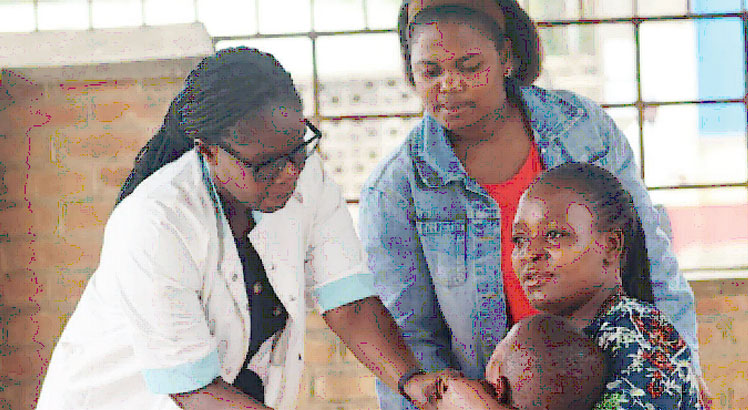
Nthanda’s mother, Grace Kayira, gently pulls up the girl’s blouse, exposing her shoulder before the health worker sticks the injection into the upper arm. In three seconds, the needle is already in and out.
Then comes a drop of vitamin A, shot straight into the girl’s mouth as she cries. With a smile flashing across her face, Kayira gently pulls the protesting child close to her chest as she comes to terms with the piercing, while another health worker paints her little finger.
Mission accomplished.
“To win the fight against measles, we need every child to be vaccinated. Even those who received routine immunisation need to be vaccinated again. Those who are reluctant, we cannot force them. We let them go to think about it,” says disease control and surveillance assistant Alice Chisaka after administering the jab.
Next!
As Chisaka’s vaccination team was hard at work, volunteers had hit the road, inviting parents to bring their children for vaccination at the clinic.
The frontline healthcare worker contentedly moves on to another child on a forming queue.
A similar vaccination campaign was in session at St Vincent Health Centre in Chazunda, about 25 kilometres away.
The Ministry of Health and Sanitation has launched a measles-rubella vaccination campaign to combat the global public health threat that claims 95 000 lives annually.
The women dropping in could not wait to protect their children from the disease prevented by the vaccine on offer.
Francis Aufi, another DCSA, was surrounded by women calming down restless children under a mango tree. He moved from one child to another, administering the vaccines.
One by one, the vaccinator, a community health worker formerly called a health surveillance assistant, added children to Malawi’s growing shield against the preventable illnesses.
“Measles and rubella are dangerous to children and they can be fatal. They can cause pneumonia and brain swelling. Today we are moving door-to-door to leave no child behind, but tomorrow we will be at the nearby primary school to continue with the campaign,” he said on Monday.
Aufi was excited by parents’ willingness to present their children to be vaccinated.
The Ministry of Health and Sanitation has rolled out a massive vaccination campaign targeting at least 5.8 million children aged nine months to nine years.
The country recorded 376 measles-rubella cases between January and August this year, the ministry reports.
“The campaign is intended to close existing immunity gaps,” said Minister of Health and Sanitation Madalitso Baloyi last Friday when she launched the nationwide initiative in Blantyre.
Her ministry reports that about 85 percent of children in the country receive the first dose of measles-rubella vaccine as part of early childhood immunisation, but the figure drops to 68 percent by the second shot. The vaccine uptake falls below the 95 percentage minimum required to avert measles-rubella outbreaks, WHO reports.
The gap keeps the deadly virus lurking, creating a bridge for possible outbreaks that could erode the gains achieved when a country achieves herd immunity threshold.
WHO country representative Dr Charles Kuria Njuguna says measles remains a global challenge, with about 11 million cases that claimed 95 000 deaths in 2024. About 2.6 million patients and 33 000 deaths were reported across the 47 countries in the WHO Africa Region.
“These figures remind us that measles remains a serious public health threat—one that demands sustained, collective action to reduce risk and protect our communities,” he says.
Meria Joseph, one of the mothers who brought children to Aufi’s outreach, says she cannot let her son suffer a deadly disease prevented by a vaccine.
“I heard from church yesterday that we should bring our children to vaccination centres,” she said.
The campaign, which started on Monday, ends tomorrow.