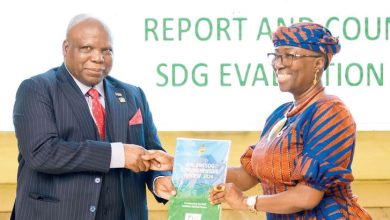
Minister of Finance, Economic Planning and Decentralisation Joseph Mwanamvekha says government officials will hold further talks with the International Monetary Fund (IMF) early next year to determine a more suitable arrangement for the country.
The minister’s comments follow a meeting government officials had with the IMF staff team led by Justin Tyson from November 3 to 7 where they discussed recent economic developments and near-term policy priorities to support macroeconomic stability and growth.
In an interview on Tuesday, Mwanamvekha said the engagement with the global lender will decide whether the country will begin with a staff monitoring programme or proceed directly to an Extended Credit Facility (ECF).
He said the upcoming discussions follow a productive IMF scoping mission, which reviewed the country’s fiscal and monetary situation and laid the groundwork for future collaboration.

Said Mwanamvekha: “We are happy with the outcome of the recent IMF mission meetings. The meetings were quite productive and beneficial to Malawi and it has laid a good foundation for our future engagement with the IMF.
“I would like to assure Malawians that Malawi and IMF stand with Malawian people particularly those in the rural areas and that we cannot go into a programme that hurts the very people that we want to protect.”
IMF Staff Monitored Programme is an informal agreement between an IMF member country and IMF staff to monitor the member country’s economic programme.
The programme is used when an IMF member country is not yet able to implement an IMF-supported programme.
This means that the programme can pave the way for an IMF financial arrangement or for the resumption of a financial arrangement that had gone off-track.
In November 2023, Malawi secured a four-year ECF worth $175 million to stabilise her ailing economy, which helped to unlock direct budgetary support from multilateral institutions such as the European Union (EU).
But the programme automatically terminated on May 14 2025, 18 months without completing a review.
However, since 1995, Malawi has engaged in seven different ECF-supported programmes, focusing on a similar set of objectives; fiscal adjustment, public finance management, exchange rate flexibility and increasing forex supply, lower inflation, improving debt management and debt dynamics and structural reforms targeting fiscal governance and limiting fiscal risks.
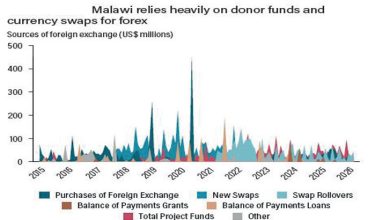
In addition, Malawi has benefited from high grant-based support from the donor community.
IMF lending over this period also included non-programmatic financing with four emergency facilities.
However, progress on IMF-supported programmes was mixed; three fully disbursed but the others ended soon after approval, resulting in an average disbursement rate of 60 percent, according to IMF data.
Despite prolonged engagement with the IMF, macroeconomic outcomes have been moderate with the country’s real gross domestic product (GDP) growth averaging only 4.4 percent over these 30 years.
In December 2024, a study by consultant Winford Masanjala under the leadership of Oxfam in Malawi together with the Economics Association of Malawi, Malawi Economic Justice Network, Youth and Society, Civil Society Agriculture Network and Centre for Social Accountability and Transparency, observed that Malawi’s engagement with the IMF is characterised by non-compliance to agreed performance targets and structural benchmarks, resulting in non-completion of reviews and subsequent suspension or cancellation of facilities.
At the conclusion of the IMF staff visit last week, team leader Justin Tyson said the macroeconomic challenges for the new government are significant, including a worse-than-budgeted fiscal outturn at midyear, accelerated inflation and continued pressure on the exchange rate.
He also observed that growth is projected to remain modest at 2.4 percent in 2025, and food insecurity is elevated amid unsustainable public debt dynamics.
Said Tyson: “Staff agreed that urgent fiscal consolidation and tighter monetary policy are needed to tackle inflation, reduce imbalances and stabilise the foreign exchange market.
“Staff commend the authorities for reactivating the automatic fuel price mechanism and encourage them to operationalise the promised fiscal discipline and revenue mobilisation, starting with the mid-year budget. Recent measures to control expenditure are a positive sign.”